Brunch Over Books – Sip ‘n’ Swap in Accra!

Ever since I moved to Accra in 2014, I’ve really been missing the variety of literary events I used to attend back in Boston and Middlebury. But Accra has its own selection of events I’ve been enjoying. Writers Project Ghana has been spearheading the literary scene with the plethora of events they host, like – Ghana Voices Series: where bookworms and literary fiends gather for monthly public book readings featuring African writers who visit Accra; Writers Project on Citi FM: an hour of poetry readings and updates on literature-related events in Accra on the radio waves; writers workshops, book club meetings and more! With respect to book festivals, GAWBOFEST – Ghana Association of Writers Book Festival has been a recurring book festival for 5 years now. Hopefully I’ll find time to finally attend this year’s event in September. Also later this year, the Storymoja Festival will be in Accra (not Nairobi, Kenya) – so that will be exciting!

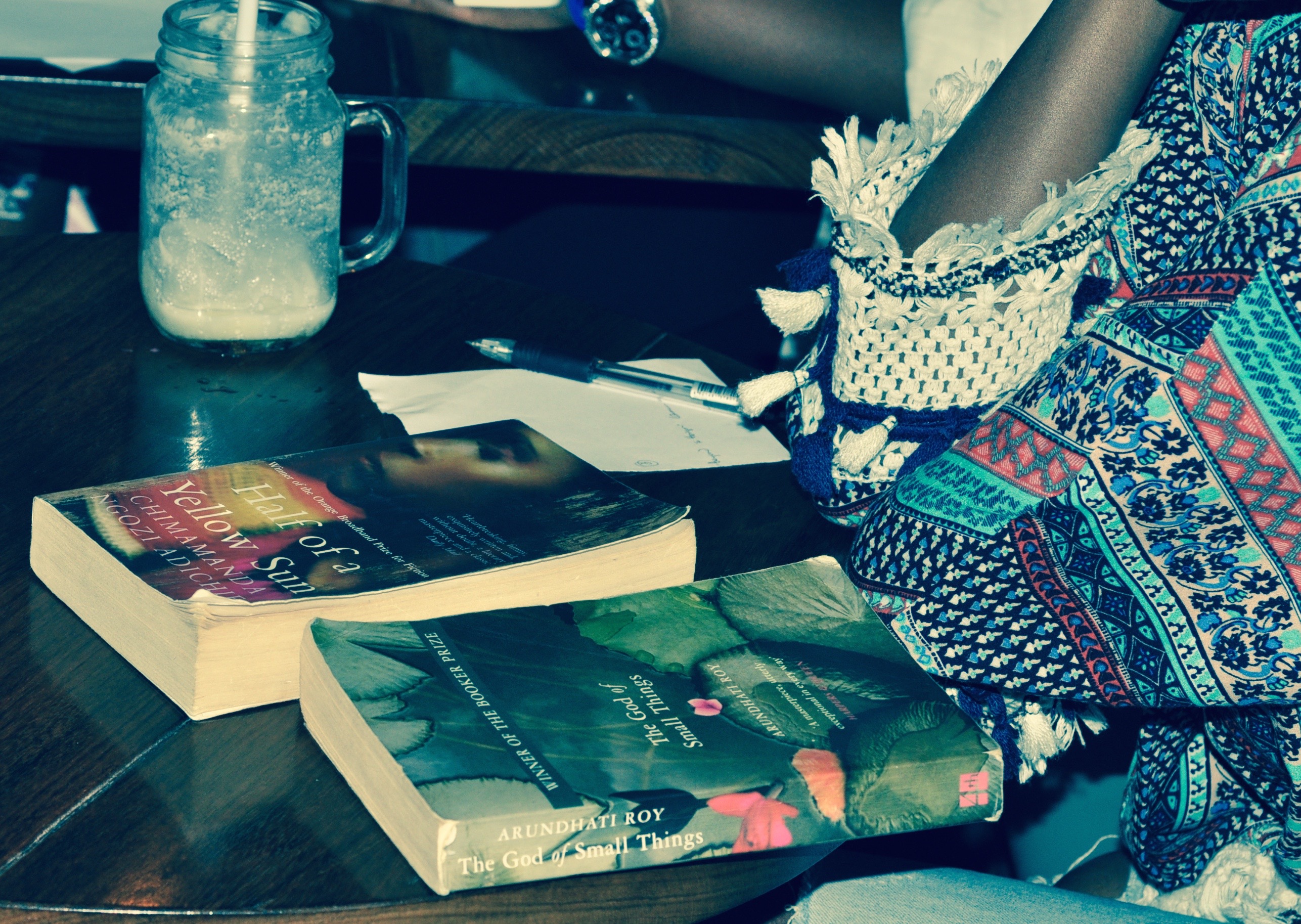
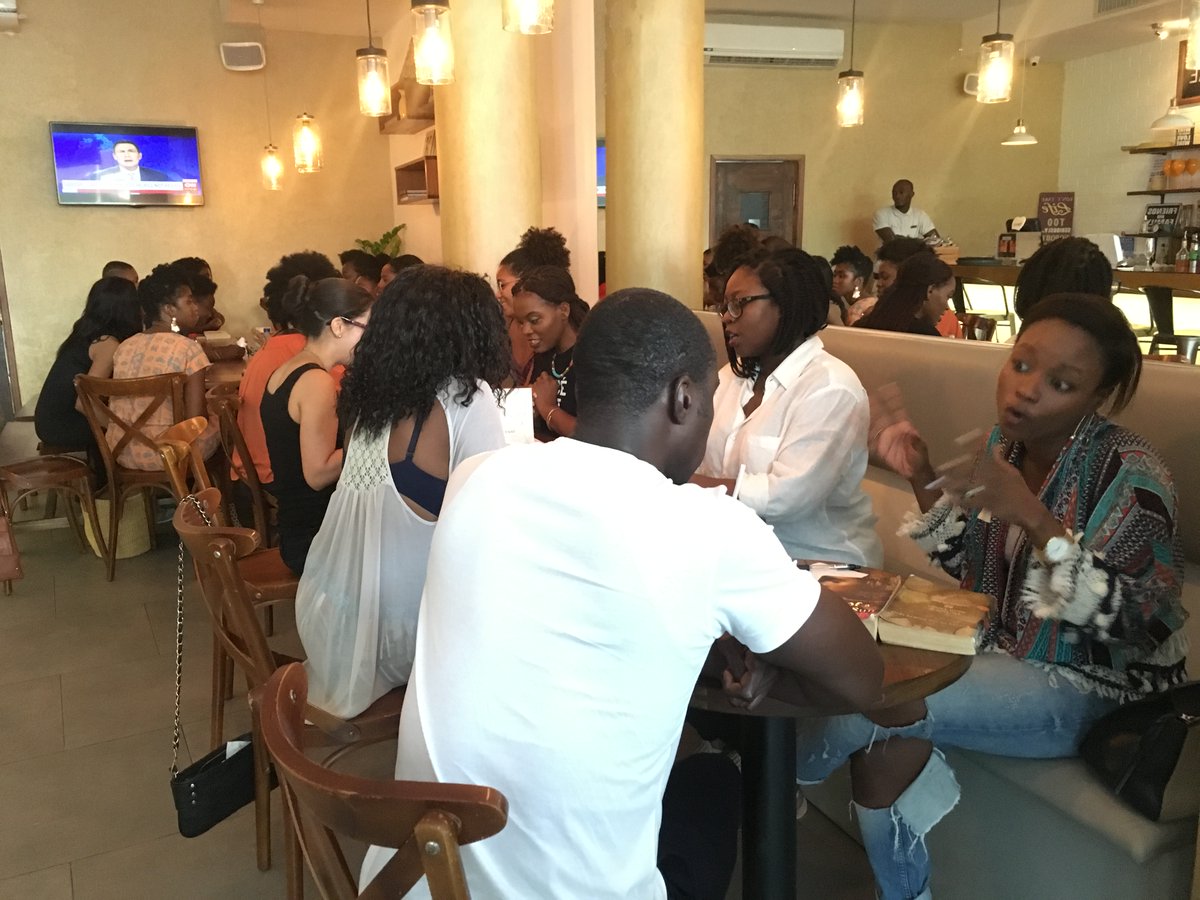
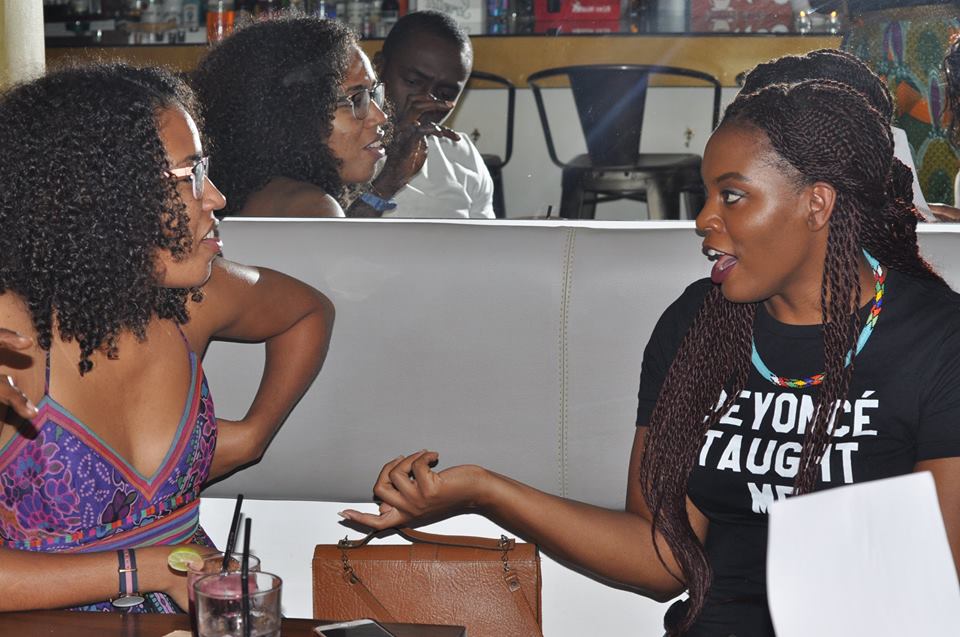
To add to the eclectic and ever growing bunch of literary events in Accra is – Brunch Over Books! Two weeks ago, Brunch Over Books – a Sip ‘n’ Swap book exchange was inaugurated at the quaint Café Kwae, in Accra. This maiden event, curated by the lovely Nana Konamah (@nanakonamah), attracted lots of bookworms, book bloggers and page slayers to sip yummy drinks and exchange book titles and actual books! After a speed book exchange activity, I jotted down a couple of book recommendations, met some folks I had been following (or stalking) on social media – like Ghanaian bibliophile, Shika of @bookpress on Instagram (@bookpresse on Twitter) and just geeked-out over books with fellow book lovers who also recently moved to the city, and long time residents of Accra!

Images via Brunch Over Books

As per my Book Chat post on book lending – you know me! I do not lend or exchange books (sorry, not sorry). So for this event, I purposely purchased a new copy of Beyond the Horizon by Amma Darko (a Ghanaian book and author I believe is seriously underrated) for whoever wanted to swap with me – but for the person to KEEP.

Its always refreshing when you can converse with book lovers and discuss why you loved/disliked certain novels. If you live in Accra, try and come to the next Sip ‘n’ Swap event! Rumor has it that the next gathering will be in August. I can’t wait to see what new activities and conversations we’ll have over yummy cocktails.

What type of literary events do you usually attend? Have you ever been to any book festivals, public readings (I feel like public readings are standard go-to’s for book lovers, right?), book signings, book exchanges, book blogger meet-ups? How many times a year do you attend literary events? Please do share!

#SummerReads 2016 – TBR


IMG_4111

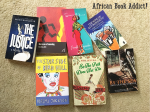
Hey everyone! Summer break is finally here and there are a couple of books I’d like to read before the end of the break. 7 books on my Summer TBR (to-be-read list) – too many books, or nah?

Please click on the titles below to read more about the books on Goodreads.

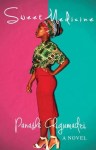
sweet medicineSweet Medicine by Panashe Chigumadzi 

Sweet Medicine is a book I had been trying so hard to get my hands on. I even double ordered it – by mistake, but I don’t regret it. One thing that drew me to this book was the chic book cover and the fact that Panashe Chigumadzi is only 25 and is doing amazing things for the continent! I finished Sweet Medicine about a week ago and it was an enjoyable read. Expect the review to go up at some point during the summer.


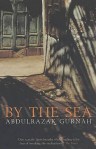
By the seaBy The Sea by Abdulrazak Gurnah

I saw a review of By The Sea on fellow book blogger (and one of my faves!) – Mary Okeke’s book blog some years back and added it to my TBR. This story is set in Zanzibar, Tanzania – a place I REALLY would love to visit one day! From a series of Goodreads reviews I’ve seen, I hear its best to read this slowly to fully get the impact of the story. I plan on doing exactly that!


The Star Side of Bird HillThe Star Side of Bird Hill by Naomi Jackson

The Star Side of Bird Hill may look familiar to some of you, as its been featured on quite a few of my posts – 2015 New Releases To Anticipate & the TBR Book Tag. Don’t you just love the book cover? Super sassy! Jackson actually wrote a piece about the book cover on the Literary Hub last year. I actually finished The Star Side of Bird Hill earlier this June. Expect a review soon!


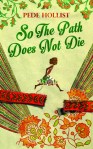
pede hollistSo The Path Does Not Die by Pede Hollist

The first time I heard about Pede Hollist was back in 2013, when he was shortlisted for the Caine Prize for African Writing. So The Path Does Not Die was published back in 2014 and follows a young girl, Finaba (or Fina) from Sierra Leone. I haven’t read much from Sierra Leone, so I hope to learn a thing or two about the West African nation from this novel!


The justiceThe Justice: A Political Thriller by Boakyewaa Glover

Boakyewaa Glover was kind enough to gift me with this book, along with her sci-fi novel – Tendai (which I read and really enjoyed back in May – expect a review soon!). I’ve been looking forward to reading The Justice since the beginning of the year. I’m excited to read this political thriller 🙂


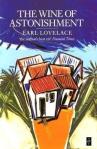
Earl LovelaceThe Wine of Astonishment by Earl Lovelace

I’m sure this book looks familiar to some of you. The Wine of Astonishment was featured in my 2015 Summer Book Haul. I hope I get a chance to finally read it this summer, as I hear its a Trinidadian classic!


born-on-a-tuesdayBorn on a Tuesday by Elnathan John

I purchased Born on a Tuesday back in March, after attending a reading by Elnathan John here in Accra. Elnathan John was also shortlisted for the Caine Prize for African Writing – in 2013 and 2015. I really like Elnathan John’s writing (his satire blog is quite hilarious. Check out his blog: Elnathan’s Dark Cornerhere). I prefer this vibrant book cover by Cassava Press. The book covers for the American and British editions aren’t appealing to me at all. I like this Nigerian cover 🙂


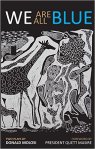
We Are All BlueWe Are All Blue by Donald Molosi

In collaboration with the Writivism Book festival taking place in Kampala, Uganda – August 22-28, I shall be posting a review of We Are All Blue by Donald Molosi! This book was on my 2016 New Releases To Anticipate post. I’m especially excited that We Are All Blue is a collection of 2 plays that take place in Botswana. Indulging in a playwright from a country I’m not familiar with will be fun. Stay tuned for the review 🙂


 Last year I was able to knockout 8 books during the summer break. I’m not sure I’ll be able to read all 7 of these books before the end of the summer – as I don’t plan on reading my break away. We’ll see! If these aren’t read by the end of the summer, hopefully they’ll be read by the end of the year – no pressure here (its not that serious).

IMG_4080

Have you read any of these? What books are on your Summer TBR? Please share some of your summer reads! New recommendations are always welcome 🙂

And the 2016 Caine Prize winner is…

Yes, it’s that time of year again! In about two weeks, the 2016 Caine Prize winner will be announced!

For those who are not familiar, the Caine Prize for African Writing, which was first awarded in 2000 is an award “open to writers from anywhere in Africa for work published in English. Its focus is on the short story, reflecting the contemporary development of the African story-telling tradition” (source).

Some notable winners of the Caine Prize include (click on links to my reviews):

  • Leila Aboulela, from Sudan (2000) – author of novels Minaret, The Translator, Lyrics Alley among other works. 
  • Binyavanga Wainaina, from Kenya (2002) – founding editor of Kwani?, author of memoir One Day I Will Write About This Place and the essay How To Write About Africa found in various literary magazines.
  • Yvonne A. Owuor, from Kenya (2003) – author of the novel, Dust.
  • E.C Osondu, from Nigeria (2009) – author of the novel, Voice of America: stories.
  • NoViolet Bulawayo, from Zimbabwe (2011) – author of the novel, We Need New Names

Previously shortlisted authors include: Mia Couto from Mozambique (2001), Chimamanda Adichie from Nigeria (2002), Laila Lalami from Morocco (2006), Chinelo Okparanta from Nigeria (2013), Tendai Huchu from Zimbabwe (2014), Elnathan John from Nigeria (2013 & 2015), among others!

The Caine Prize and its shortlisted stories play a huge role in the authors I read from the continent. Many Caine Prize winners and shortlisted writers have found great success and I’ve reviewed a good number of these writers’ works here on African Book Addict!


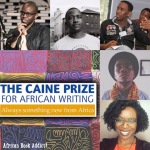
This year, the Caine Prize shortlist comprises of five talented young writers with unique short stories (top left to bottom right):

IMG_4122

(Images via caineprize.com ; collage created by African Book Addict!)

Tope Folarin (Nigeria) – Read his short story: Genesis

Bongani Kona (Zimbabwe) – Read his short story: At Your Requiem

Abdul Adan (Somalia/Kenya) – Read his short story: The Lifebloom Gift

Lidudumalingani (South Africa) – Read his short story: Memories We Lost 

Lesley Nneka Arimah (Nigeria) – Read her short story: What It Means When A Man Falls From The Sky

I was surprised to see Tope Folarin shortlisted AGAIN, since he won the Caine Prize back in 2013 for his moving story – Miracle. Why does the Caine Prize always shortlist past shortlistees and winners? Every year, many writers submit stories in hopes of being shortlisted – they couldn’t give someone else a chance to compete to win?

Anyways, Folarin’s Genesis reminded me of his Africa39 story, New MomGenesis is a semi-autobiographical story on Folarin’s family – more specifically on his mother’s mental illness and how it affected him as a child. Genesis made me uncomfortable. I felt stressed reading the story as Folarin freely shares with the world his mother’s plight. The story is an easy read and quite engrossing which I expected, since Folarin’s strength is in his ability to write moving stories – as seen in Miracle. I appreciate Folarin shedding light on mental illness and depression – topics we Africans usually shy away from. But for some reason, I’m not okay with his mother’s illness and antics being shared with the world (MY opinion!). If he wins the Caine Prize again, I anticipate some uproar from readers and critics.

Lesley Nneka Arimah’s story, What It Means When A Man Falls From The Sky was an engaging story. This is a story about Nneoma who is a Mathematician that can detect grief and sadness from fellow Nigerians and has the power to heal them. She seems to be searching to find the next genius mathematician to train with healing powers as well. The ending had me a bit confused… But this was an enjoyable read. I’m not a big fan of science fiction but I loved the afrofuturism vibes I got from this story!

Abdul Adan’s story The Lifebloom Gift is my favorite! This story is sooo bizarre. The Lifebloom Gift is a story about a TSA officer who has an encounter with Ted Lifebloom – a 30 year old man who seems to thrive off touching moles on other peoples’ bodies. Once Ted Lifebloom touches another person’s mole, the person he’s touching is transported into a land of “green pastures where they hear the song of birds and sneezes of horses, smell the fur of dogs, feel a twitch in one of their nipples which, in turn, transforms into a brown lactating nipple…” or in short, the person understands the meaning of love (whaaat?!). The TSA officer later conducts a case study on Ted Lifebloom and goes on an adventure to find other Lifebloomers, by accessing moles on the backs of potential Lifebloomers. The story starts off a bit confusing, as it’s hard to picture what Abdul Adan is describing. But as the story unfolds, it all starts to make sense even though its still very strange. It’s actually hard to explain this story. But it was hilarious to read and oh so weird! If you don’t read any of these stories at all, at least read The Lifebloom Gift! It’s truly an original and creative story. I hope Abdul Adan wins the 2016 Caine Prize!

Which story is your favorite? Who do you think will win the Caine Prize this year?

The winner will be announced on the 4th of July at the Weston Library, Oxford, England. Good luck to all the shortlisted candidates!

You can also check out my commentary on the Caine Prize from 2014 – here & 2015 – here :).

Poetry | bone & Teaching My Mother How To Give Birth

Hey everyone! In my review of salt. by Nayyirah Waheed, I listed a bunch of contemporary poets and my keen interest to enjoy their works in the near future. Yrsa Daley-Ward and Warsan Shire were on that list and I finally read their collections (e-books) a couple of months ago.

Below are two mini reviews of the poetry collections by two popular poets grabbing peoples’ attention in 2016.

bone by Yrsa Daley-Ward 

boneDate Read: April 12th 2016

Published: June 2014

Publisher: CreateSpace Independent Publishing

Pages: 136


The Blurb

Bone. Visceral. Close to. Stark.


Review –★★★★ (4 stars)

bone is a brilliant collection of poems. I enjoyed reading the long poems in this collection, as they read like short stories and were packed with lots of suspense and emotion!

Most of the poems in bone have recurring themes of death, sex, family, relationships and Christianity. Yrsa Daley-Ward blends her West Indian (Jamaican) and West African (Nigerian) cultures beautifully in this collection, especially with her references to foods like Jollof rice, stereotypical Black woman mannerisms like eye-rolling and sucking of teeth etc.

Some of my favorite quotes:

Loving someone who hates themselves is a special kind of violence. A fight inside the bones. A war within the blood. (pg. 12)


If you were married to yourself could you stay with yourself? My house would be frightening and wild. (pg. 53)

Even though some of the poems read like short stories, there were healing elements to them that I really appreciated. The poems liberate you… They almost reminded me of – Nayyirah Waheed’s collection salt. bone definitely hit home and made me realize and appreciate how difficult and different peoples’ lives can be. This was an eye-opening read. Please don’t sleep on Ysra Daley-Ward!

★★★★ (4 stars) – Great book. Highly recommend!

Purchase bone by Yrsa Daley-Ward on Amazon


Teaching My Mother How To Give Birth by Warsan Shire 

Warsan shire

Date Read: March 16th 2016

Published: December 2011

Publisher: Flipped Eye Publishing

Pages: 38


The Blurb

What elevates Teaching My Mother How To Give Birth, what gives the poems their disturbing brilliance, is Warsan Shire’s ability to give simple, beautiful eloquence to the veiled world where sensuality lives in the dominant narrative of Islam; reclaiming the more nuanced truths of earlier times – as in Tayeb Salih’s work – and translating to the realm of lyric the work of the likes of Nawal El Saadawi. As Rumi said, “Love will find its way through all languages on its own”; in Teaching My Mother How To Give Birth – Warsan’s debut pamphlet, we witness the unearthing of a poet who finds her way through all preconceptions to strike the heart directly.


Review –★★★★ (4 stars)

Somali-Brit poet – Warsan Shire’s writing is biting, abrupt and shocking. Most of the poems in Teaching My Mother How To Give Birth have recurring themes of immigrant life, being a refugee, war, death, sex, relationships, womanhood, Islam (almost similar to the themes in Somali-Brit – Diriye Osman’s short stories collection, Fairytales For Lost Children). The first set of poems in this collection were pretty wild and literally had my heart racing. When I finished reading this collection back in March, I craved more because this collection was way too short. I’m definitely looking forward to Shire’s new collection of poems entitled, Extreme Girlhood- which is set to be published this Fall!

Some of my favorite quotes:

Conversations About Home (at the Deportation Center)

…No one leaves home unless home is the mouth of a shark. I’ve been carrying the old anthem in my mouth for so long that there’s no space for another song, another tongue or another language.

I know a few things to be true. I do not know where I am going, where I have come from is disappearing, I am unwelcome and my beauty is not beauty here. My body is burning with the shame of not belonging, my body is longing. I am the sin of memory and the absence of memory. I watch the news and my mouth becomes a sink full of blood. The lines, the forms, the people at the desks, the calling cards, the immigration officer, the looks on the street, the cold settling deep into my bones, the English classes at night, the distance I am from home. But Alhamdulilah of all of this is better than the scent of a woman completely on fire, or a truckload of men who look like my father, pulling out my teeth and nails, or fourteen men between my legs, or a gun, or a promise, or a lie, or his name, or his manhood in my mouth.


Birds

Sofia used pigeon blood on her wedding night.

Next day, over the phone, she told me

how her husband smiled when he saw the sheets, 

that he gathered them under his nose, 

closed his eyes and dragged his tongue

over the stain.

She mimicked his baritone, how he whispered

her name – Sofia, 

pure, chaste, untouched. 

We giggled over the static…

I knew Warsan Shire was a talented poet back in 2013 and was aware of all the accolades she’s been awarded over the years. Thanks to my 2016 Reading Goals to incorporate more poetry into my reading challenge, I decided to finally give Shire’s poetry a try and I must say – I’ve been blessed by her work!

After Beyoncé’s (visual) album – Lemonade was released back in April, I realized a lot of people were finally paying more attention to Warsan Shire’s amazing work. Before Beyoncé’s Lemonade album, I didn’t really hear people (more specifically- not fellow Africans) talk much about Warsan Shire. I made a Facebook status about this observation and it gathered quite a few comments:

IMG_3920

I respect that everyone has their own preferences when it comes to literary works, but I’ve realized that we (Africans) tend to only celebrate the celebrated. Once a big celebrity from the US or UK praises someone from our continent for their craft, all of a sudden we (Africans) start taking notice of the person and are suddenly proud to have them as African (whichever country they hail from). These are just my observations! Anyways, the Facebook post later inspired the four Nigerian women of Not Your African Cliché Podcast  to talk about Warsan Shire, Chimamanda Adichie, Beyoncé’s album Lemonade and the importance of us supporting artists from our continent. I was invited to join the ladies on the podcast to discuss these topics and so much more! Check out the short description of the episode below:

“Although late to the ‪#‎Lemonade dissection game, the ladies of NYAC discuss a less explored running theme in Beyonce’s last two albums – her collaborations with brilliant African writers; Chimamanda Adichie on self-titled Beyoncé and Warsan Shire on Lemonade. Joined by book blogger extraordinaire and longtime listener/supporter Darkowaa (@AwoDeee), we talk about our favorite tracks off the Lemonade album, the pros and cons of being featured in such high profile work, the limited visibility and reach African works of art have in Africa, and what it takes for African artistry to gain a wide following.”

https://soundcloud.com/not-your-african-cliche-podcast/nyac-s1-episode-12-african-artists-western-collaborators-and-lemonade

Please listen to this episode if you have 59 minutes to spare! If you want to just dive right into the topics, you can start listening from 18 minutes 52 seconds – but I highly recommend you listen to the whole episode, it was a great discussion! Feel free to join the discussion with your comments! Also, don’t forget to subscribe to Not Your African Cliché Podcast on iTunes, Soundcloud and follow them on Twitter (@NYACpodcast) as well!

All in all, I truly enjoyed and learned a lot from the works of Yrsa Daley-Ward (above on the left) and Warsan Shire (above on the right). Their poetry makes me proud to be a black woman. I’ll surely be purchasing the physical copies of these books to add to my bookshelf soon 🙂

★★★★ (4 stars) – Great book. Highly recommend!

Purchase Teaching My Mother How To Give Birth by Warsan Shire on Amazon

Saturday’s Shadows by Ayesha H. Attah

Date Read: February 27th 2016

Published: January 2015

Publisher: World Editions

Pages: 352

Saturday's Shadows

The Blurb

The protagonists of Saturday’s Shadows experience the fine line between sanity and madness as they try to find and hold on to love in the volatile world of 1990s West Africa. After a seventeen-year military dictatorship, a country tries to find it’s footing while the members of the middle-class Avoka family lurch towards destruction. They live in a politically complex climate, a time so tenuous that the country could easily dip back into its military past.

 ◊◊

Review – ★★★ (3 stars)

Saturday’s Shadows is a multi-voice novel about the Avoka family in an unnamed West African country. Readers meet Theo – the head of the Avoka family, who is working on the president – Dr. Karamoh Saturday’s memoir and might be caught up in dangerous political risks. His wife is Zahra, who works in the farming industry but is pre-occupied with re-living her past love life with an old flame. And there’s Kojo, their only child who is struggling to keep up with schoolwork at the prestigious International Secondary School. Atsu, the Avoka family’s house help is straight out of the village and is busy balancing learning to read and write English while trying to stay out of trouble with a suspicious man who admires her.

Saturday’s Shadows is a decent novel and Ayesha H. Attah does an amazing job with character development. Character development is a huge strength of Ayesha Harruna Attah’s and I remember truly enjoying the character development of characters like Sugri and Akua-Afriyie in Harmattan Rain back in 2014. My favorite character in Saturday’s Shadows is Kojo. He is such a witty, hilarious, typical teenage boy with insecurities and worries of growing up. I was always happy to read his chapters in this novel as he finds young love and struggles with bullies and Math at school. My least favorite character in this novel is Kojo’s mother – Zahra. She’s such selfish mother and wife! Throughout the book, she only lives to satisfy her own wants and needs, which put her health and marriage at risk. Theo Avoka’s chapters are intriguing as well. He gives the novel a political feel, which is a different dimension to the family-oriented theme of this novel.

Because this story takes place in an unnamed West African nation, the different characters have various names of West African origin. For example, some characters have Nigerian names like Kunle and Ngozi ; Ghanaian names like Atsu and Kojo ; Senegalese names like Ndeye and Diouf. This may seem trivial, but I really loved how there was a cute blend of West African names in this novel! But it took me 2 months to finish Saturday’s Shadows – I started it a day after Christmas and ended up taking a break from the book when I got to page 260 or so. I think I was just craving a story that was more fast-paced and exciting. Why did all the good action have to happen on page 300, almost towards the end? After I picked this up again in February, I found the storyline to be a bit predictable. I’m a huge fan of Ayesha H. Attah’s work, but this book wasn’t as exciting for me as Harmattan Rain. Definitely read this book if you enjoy character development and a family themed story!

★★★ (3 stars) – Good book. I recommend it, I guess.

Check out some photos from the Saturday’s Shadows book reading I attended back in 2015 – here.

Ayesha H. Attah is working on a new novel called One Hundred Wells of Salaga! Read more about it – here. I’m excited for it!!

IMG_3141

Purchase Saturday’s Shadows on Book Depository

LIT Links mélange

Hey everyone!

Here are links to some great resources, literature finds and gems I’ve been loving and just had to share. Enjoy!

Thanks to my 2016 Reading Goals, I’ve been slacking on my Carib reads this year – but that will be rectified very soon! The annual Bocas Lit Fest – Trinidad and Tobago’s Literary Festival took place about a week ago and some great Caribbean writers received prizes for their awesome works. The OCM Bocas Prize for Caribbean Literature is a major award for literary books by Caribbean writers. Books are classified in three categories: poetry, fiction, and literary non-fiction. Below are the book covers of the works that made the OCM Bocas Prize Shortlist:

2016-ocm-bocas-prize-shortlist-covers

The winner of the 2016 OCM Bocas Prize for Caribbean Literature was announced last weekend to be Jamaican writer, Olive Senior for her collection, The Pain Tree! Olive Senior has been on my TBR for a while and this win just reminded me to bump her up my TBR list. As one of the pioneer Caribbean writers, in my opinion I don’t think Olive Senior gets enough shine for her contribution to Caribbean Literature. Below is a showcase of some of her work from 1987 to present day:

Add Olive Senior to your TBR, maybe?

  • Self-published short stories collection: Flight

Fellow book blogger – Stephanie, of Steph Hearts Books (check out her blog!) published a collection of short stories called Flight back in December (2015) on Tumblr. From her blog, she describes the collection – ‘Flight is a multimedia collection of short stories that uses photo, film, and written text to explore themes of escapism for black women. The collection features 4 short stories, films, and photosets’.

I finally just finished reading the collection and I’m really impressed! The first story entitled ‘Thelma’ (which actually ties in well with present day police brutality in the U.S and the constant fear black mothers face for their sons) will reel you in to reading the rest of the stories in this great collection. Stephanie is a talented writer and a lot of emotions are accurately expressed in these stories! Please do check out Flight and share the collection with your friends once you finish reading! Stephanie is also a contributor for Blavity and I enjoy the content she produces there as well.

  • How Not To Talk About African Fiction by Ainehi Edoro

Ainehi Edoro of Brittle Paper wrote an important essay that was published in The Guardian, entitled How Not To Talk About African Fiction. The title of the essay reminded on me of Binyavanga Wainaina‘s satirical essay (2005) – How To Write About Africa which I thoroughly enjoyed in an Anthropology class I took junior year in college (2010/2011) – shoutout to Prof. Sheridan! Anyways, with regards to Ainehi Edoro’s essay – I wholeheartedly agree with everything that’s said. African fiction deserves to be seen as literary work of art instead of solely being appreciated for its ‘anthropological value’. It’s unfair to market African fiction around the social/political issues they address because there’s so much more to these stories that go unseen from how they are described by publishers and even reviewers of African fiction. I think book bloggers and reviewers should try and rectify this issue by adequately portraying the layered complexities of African fiction. What do you all think?

  • Big Belly Ache

Big Belly Ache is captivating artwork I discovered on Instagram months ago by New York based illustrator and writer, Elaine Musiwa. She showcases her work at @bigbellyache where she boldly portrays images that represent varied black women experiences. I enjoyed a conversation Elaine Musiwa had with LAMBB (Look At My Black Beauty)here. Key quotes I got from this interview were:

“The name Big Belly Ache came out of this idea; tackling the topics that are hard to stomach or admit. When I was growing up it took a long time for me to embrace having bold features like a wide nose, large lips, puffy hair, thick thighs, a large ass; all the things that were part of my genetics. This statement art is representative of my progress in self-acceptance”

“Words often leave a need for translation but the beauty of images is that they can be understood worldwide” (Yesss!)

“I hope my images are inspiring young black girls to tell their stories and support each other. As black women, one of our biggest challenges has always been to encourage each other and find our voices in mainstream dialogue”

(quotes taken from Elaine Musiwa’s insightful interview with LAMBB (Look At My Black Beauty)

Below are my favorite illustrations from Big Belly Ache. Enjoy!

Images via bigbellyache.com

  • More Short Stories!

Have y’all been keeping up with AFREADA? There are some really talented writers from the continent and in the diaspora who have been sending in brilliant stories which I have been enjoying! Some stories I really, really love are: The Disappearance of Self by Zainab Omaki (Nigeria), A House in the Sky by Mirette Bahgat (Egypt) and My Father’s Shadow by Kariuki WaKimuyu (Kenya). There are also photo-stories as well as book reviews (by yours truly) on AFREADA‘s website. Head on over there and indulge in great short fiction 🙂

Let me know which of these LIT links intrigued you the most and please share some interesting links you’ve been loving as well! 

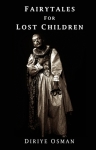
Fairytales For Lost Children by Diriye Osman

Date Read: January 7th 2016

Published: September 2013

Publisher: Team Angelica Press

Pages: 156

Diriye Osman

The Blurb

Fairytales For Lost Children is narrated by people constantly on the verge of self-revelation. These characters – young, gay and lesbian Somalis – must navigate the complexities of family, identity and the immigrant experience as they tumble towards freedom. Using a unique idiom rooted in hip-hop, graphic illustrations, Arabic calligraphy and folklore studded with Kiswahili and Somali slang, these stories mark the arrival of a singular new voice in contemporary fiction.

◊◊

Review – ★★★★★ (5 stars)

*sigh*

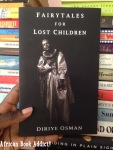
Is it too early to already know my favorite book of the year? Fairytales For Lost Children just might be the best book I’ve read this year. I read two stories a day from this collection, to adequately absorb everything in little bits. I even smoothed the velvet-textured book cover against my cheeks after reading some of the stories (no, I’m not a weirdo… maybe a little haha). And when I was done reading Fairytales For Lost Children, I wanted more. I need Diriye Osman to write a full novel soon!

This collection of short stories is raw, erotic, sassy, vivid, devastating and most importantly, liberating. These stories are set in modern day Somalia, Kenya and London. The characters of these stories just want to be loved for who they are. They desire to live their lives free from hate, criticism, and scrutiny, while trying to understand the intersectionalities of their own identities.

There are eleven stories in this collection and I loved how Diriye Osman precedes each story with his beautiful artwork, which visually summarizes each tale. Osman also incorporates lots of Neo-Soul (my ultimate favorite music genre) and old school Hip-Hop music into the stories. He refers to Meshell Ndegeocello’s 2002 soul album, Comfort Woman in about three of the stories, so I just had to purchase that album after I read this collection! Osman also blends languages like Somali, Arabic and Swahili into these stories, which make them feel authentic. I deeply enjoyed each and every one of the stories (which is rare for a short stories collection – there are always one or two stories I don’t care for) but my faves were:

Shoga‘ – This tale was pretty explicit but entertaining and heartbreaking at the same time. A displaced seventeen year old Somali boy lives with his grandmother, Ayeeyo, in Kenya. He falls in love with Boniface – the domestic help who is a refugee from Burundi. After enjoying many nights of listening to Bob Marley, smoking marijuana and sleeping with Boniface in his quarters, this seventeen year old later has to deal with the consequences of his pleasures by facing his grandmother – before her time is up.

Earthling‘ – This is a story that follows Somali-Brit – Zeytun, who suffers from psychosis and deeply desires love from her family – more so, from her sister. Her only family and support system is her girlfriend, Mari, who admirably stands by Zeytun and aids in her mental and emotional healing. The love exhibited between this lesbian couple was eye-opening and comforting to me.

Your Silence Will Not Protect You‘ – This story is preceded by Diriye Osman’s artwork that actually looks like a portrait of himself (he’s the man on the book cover by the way!), so I’m assuming this tale is loosely based on his personal story. Osman boldly narrates the series of events that lead to him coming out to his family, and how he boldly deals with the pain of rejection.

The Other (Wo)man‘ – I’ve never read a story like this before. Yassin is a young, twenty-two year old Somali man living in London, pursuing his art degree and is ready to start dating. He meets a middle-aged, British-Jamaican man who works as an army pilot on a dating website (Gaydar) and they go on a couple of dates. But one night, Yassin realizes that the British-Jamaican man’s fetishes not only offend him, but actually push him to maybe trying something he never thought he’d consider. This coming-of-age tale had me sooo worried. But I loved observing Yassin as he strived to understand his ever evolving identities.

My favorite quote from ‘The Other (Wo)man‘ as Yassin takes a walk towards Peckham Rye:

He felt his sense of Somaliness slipping away from him and he was afraid of letting it go, afraid of the moral, psychological and social anarchy its loss threatened to create within him. But at the same time, what was he really hanging onto? A sense of social allegiance? But wouldn’t he be automatically excluded from his community because of his sexual orientation wherever his own allegiance lay? He didn’t belong to just one society: he was gay, Somali, Muslim, and yet all these cultural positions left him excluded… He was Somali first, Muslim second, gay third. But perhaps that hierarchy was only a matter of timing: born Somali, raised Muslim, discovered gay. And now he was venturing out into the world without a sense of his place within it and this frightened him. Yet he realized that he couldn’t mourn what was lost but instead had to consider what was to be gained. He knew he would never belong but did he really want to? (pg. 137)

This collection of short stories is probably the best LGBTQ-themed African fiction out there. I totally understand why Diriye Osman won The Polari First Book Prize back in 2014. Osman’s writing style is bold and fearless and I believe this collection is a priceless gem among the myriad of African fiction novels around. Please read this if you get the chance! And try not to judge the characters in the stories; just immerse yourself in the different happenings of the tales and learn from them. These stories speak volumes on being true to yourself, following your heart and the universal human need to love one another, regardless of sexual orientation, race, occupation, religion. Fairytales For Lost Children must have been liberating to write and I truly admire Diriye Osman as a storyteller and visual artist. Readers around the world will find solace in this work of art – I definitely did! I look forward to reading more of Osman’s work in the future. I’m sure whatever he writes next would be as fierce as this collection.

★★★★★ (5 stars) – Amazing book, I loved it. Absolutely recommend!

IMG_3573
  • Also!! Read Diriye Osman’s essay published in The Huffington Post (2014): To Be Young, Gay and African
  • I really enjoyed this conversation between Diriye Osman and Another Africa, where they discuss Osman’s background, musical influences and his creative process, difficulties he faced in writing this collection, future projects and so much more!

Other Somali writers I plan on reading in the future (click on their names to check out their Goodreads profiles and their collection of work): Nuruddin FarahAyaan Hirsi Ali, Warsan Shire (Somali-British), Ladan Osman (Somali-American), Nadifa Mohamed (Somali-British).

Purchase Fairytales For Lost Children on Amazon

Disgrace by J.M. Coetzee

Date Read: February 8th 2016

Published: 1999

Publisher: Penguin Books

Pages: 220

disgrace coetzee


The Blurb

At fifty-two, Professor David Lurie is divorced, filled with desire, but lacking in passion. When an affair with a student leaves him jobless, shunned by friends, and ridiculed by his ex-wife, he retreats to his daughter Lucy’s smallholding. David’s visit becomes an extended stay as he attempts to find meaning in his one remaining relationship. Instead, an incident of unimaginable terror and violence forces father and daughter to confront their strained relationship – and the equally complicated racial complexities of the new South Africa.

◊◊

Review –  ★★★★ (4 stars)

This book engrossed me from the first to the last page! I totally understand why J.M. Coetzee won several awards for this novel, including The Man Booker Prize and the Nobel Prize in Literature 4 years after the publication of this book AND even has a 2008 film adaptation of this book starring John Malkovich as the main character, Professor David Lurie. I need to find that film and watch it! I doubt it would be as good as the book, but it will definitely be worth the watch.

Professor David Lurie – the protagonist (who is portrayed as a white South African) rubbed me the wrong way from the beginning of this novel. We first encounter him in bed with a prostitute at a brothel he frequents in Cape Town. This prostitute for some reason decides to quite her job, and David starts searching for her, as he believes they share an intimate bond. Once she tells him off after he spotted her with her children walking about in town, he decides to find new sexual adventures elsewhere. Sooner than later, David finds interest in one of his undergraduate students – Melanie.

For some strange, sick reason, David believes Melanie is actually into him and he invites her to his home, makes her feel comfortable with some alcohol and sleeps with her. This happens several times during the semester, even though Melanie is clearly uncomfortable. When David is finally confronted with his inappropriate behavior by the academic board and Melanie’s father, David (who is not really ashamed of this abominable affair) quits his job and travels to the countryside where his daughter, Lucy resides. Lucy isn’t the same girl David knew her to be. She is overweight, slightly depressed and seems to be living in a trance as she resides on a farm, adjacent to Petrus – a black South African, who apparently is helpful to her.

The story takes a serious turn while David stays in the countryside with Lucy. Readers are rudely awakened by the violent, racially tense incidents that occur and the novel suddenly becomes dark and quite frightening. J.M. Coetzee does an incredible job at ceasing readers’ attention and emotions from the beginning of this novel to the end. There are heavy themes of rape, racism, violence, depression, (white) guilt, animal rights issues, new generation versus old generation, abortion, shame, feminism, sexism, satyriasis, infidelity AND disgrace – all in this novel!

When I sat back and accessed how I felt about this book after I completed it, I concluded that there were double meanings and interpretations to the events that occur in the storyline. There are lots of complexities to unravel in this book. Disgrace would make for excellent discussions in book clubs and literature classes. I have so many opinions on David and his daughter Lucy – it was hard not to judge them… but I’ll keep my opinions to myself so I don’t divulge too much of the storyline! This book definitely took a toll on my emotions and actually had me feeling offended and upset at some parts. Please be warned: if rape is a trigger for you, you might not want to read this novel.

Disgrace is excellent literary fiction, nonetheless. This was a great page-turner with intelligent, yet tender prose. I will surely read more Coetzee soon. Disgrace takes place in South Africa, but the myriad of sensitive themes addressed are certainly universal to humanity. I give this 4.5 stars. Please read this!

(I got Disgrace from a used book store [Ghana Book Trust] last summer. I found some other gems there too! Check out Challenge Update (summer); Currently Reading to see them).

★★★★ (4 stars) – Great book. Highly recommend!

Purchase Disgrace on Amazon