Book Chat :: Do you practice book polygamy?

Hey everyone!

From time to time, Iโ€™d like to pick your brains on different topics I think interest and affectย all book lovers. The last book chat –ย Do you lend your books?ย was pretty enlightening and I appreciated the various perspectives and book lending strategies you all gave!

Today, Iโ€™m really curious to know from you all:ย Do you practice book polygamy?

EpicReadsPolyg

Image via EpicReads

Letโ€™s chat, shall we?

For those who don’t know, book polygamy is the art of reading many books at a time. ‘Many’ is relative, but I believe reading more than 1 book at a time could be considered as practicing book polygamy. During the beginning of the year (January), I found myself reading 3 books at a time in order to generate some content for this book blog before I resumed school for the second semester. The 3 books I was reading were of different genres: the first book was a short stories collection (Fairytales for Lost Children by Diriye Osman), the second book was a memoir (Year of Yes by Shonda Rhimes) and the third book was an anthology (African Love Stories: an anthology ed. by Ama Ata Aidoo). I was only able to juggle these 3 books because they were of completely different genres, so it was almost impossible for me to mix up the plots.

Other than that, reading more than 1 book at a time is a bit bothersome for me – unless they are completely different types of books. For example, I’m currently reading Rupi Kaur’s poetry collection – Milk & Honey and Vรฉronique Tadjo’s novella – As The Crow Flies. I’m able to read these books with ease because they are two different types of books + I’m reading Kaur’s poetry collection as an ebook, which gives me a different reading experience as well. If the books I’m reading aren’t of different genres, I find that my brain gets hyperactive and I become preoccupied with trying to recollect all the different plots. And for me, reading is usually relaxing and enjoyable – not a frantic relay race.

How do some of you manage to read more than 1 book (of similar genres) at the same time? How do you know when to start a new book while you’re already in the process of reading one – or two books?

I recently visited book blogger veteran, Nina Chachu’s blog – Accra Books and Things, and on her July 1st blog post, she analyzed her reading habits over the last three years. In the post, she states:

So I thought I would look at my reading so far โ€“ or rather the books which I have finished reading, because I do have to admit that I usually have several books on the go at any one time. For instance at the moment, I have one which I read in the bathroom, another in bed (alternating with some library magazines/journals), one for the bus going to and from work, plus a novel to read while eating, and another via Kindle apps. And as I wrote the last sentence I realized that actually I had forgotten to mention two others which I dip into occasionally. So I think that adds up to about seven โ€“ at least as of the time of writing!

(read more from Nina Chachu’s blog post – here)

As I read that portion of her post, I was dumbfounded with admiration. I tip my hat off to all of you who can juggle 4 to 7 books at a time. That takes skills I have not yet learned!

How about you all:ย 

Do you practice book polygamy? If you do, how do you avoid mixing up the various plots you enjoy? If you do not practice book polygamy – why not?

Iโ€™d love to hear yourย opinions, experiences and someย book polygamy strategies!

Homegoing by Yaa Gyasi

Date Read: July 16th 2016

Published: 2016

Publisher: A.A Knopf

Pages: 305

Yaa Gyasi

The Blurb

A novel of breathtaking sweep and emotional power that traces three hundred years in Ghana and along the way also becomes a truly great American novel. Extraordinary for its exquisite language, its implacable sorrow, its soaring beauty, and for its monumental portrait of the forces that shape families and nations, Homegoing heralds the arrival of a major new voice in contemporary fiction.

โ—Šโ—Š

Review – โ˜…โ˜…โ˜…โ˜…โ˜… (5 stars)

Yaa Gyasi’s debut – Homegoing, is historical fiction at its best. I honestly thought Chimamanda Adichieโ€™s Americanah hit home for me back in 2013 when I read it. But Homegoing IS home. Homegoing is about my home. I never thought Iโ€™d read a book that perfectly articulates the dynamics of being Ghanaian-American. The only book Iโ€™ve read that somewhat touches on the identity complexities of being Ghanaian by blood and American (or British) by birth, was Powder Necklace by Nana Ekua Brew-Hammond (another awesome Ghanaian-American writer). I might have to re-read Powder Necklace and review it on this platform soon!

Homegoing was an emotional read – throughout! I started reading during the wake of the horrific Alton Sterling and Philando Castile police shootings of early July, so you can imagine how haunting these real life events paralleled with this particular historical fiction, which focuses on the legacy of slavery in America and Ghana. Homegoing follows two half sisters โ€“ Effia and Esi who live in 18th century Ghana and the generations after them, making Effia and Esi the matriarchs of dual lineages. Effia becomes the wench (not wife) of the British governor of Cape Coast Castle (a slave castle here in Ghana) and is the matriarch of the Ghanaian line of the family; while Esi, who is kept as a slave in the dungeons of this same Cape Coast Castle where Effia resides with the governor, is the matriarch of the American line of the family. Homegoing alternates between the descendants of the two sisters, chronologically from 18th century Ghana to present day (after the millennium), in both Ghana and the US. As with most books of the historical fiction genre, a family tree is provided on the first page of the novel which makes following the two lineages and the different family members pretty easy.

To be honest, I donโ€™t think itโ€™s possible to read Homegoing without harboring some resentment for the insanity white folks forced people of African descent to endure. From the events of the Trans-Atlantic slave trade, to the injustice and discrimination black folks faced in the American south as slaves, to the Anglo-Ashanti wars in Ghana, to present day racial tensions and disregard for black bodies, are all legacies of slavery. I truly admire how Gyasi manages to personalize slavery and its effects through the use of character development in each chapter. In every chapter, readers witness how each generation got some inheritance of slavery – be it through mass incarceration, the need to pass as white, lynching, colorism, the fragmenting of families and so much more.

As much as the terrors white folks caused black people are highlighted in Homegoing, I appreciate Gyasi for not letting Africans off the hook for being complicit in the slave trade. Unfortunately, the role African nations played in enabling slavery are  rarely addressed. All the ethnic wars, kidnapping of innocent people and trading of human beings in exchange for goods from the British, Dutch and Portuguese were all selfish, contributing factors to the slave trade and the inhumane effects they still manifest. While reading Homegoing, I kept thinking about Maya Angelouโ€™s autobiography – All Godโ€™s Children Need Traveling Shoes and her valid feelings of anger and disappointment she expressed after visiting the Elmina Castle (a Portuguese slave castle here in Ghana) in Cape Coast, Ghana back in the 1970โ€™s. I understood her anger, as she was a descendent of our people who were captured and sold to the Europeans. As upsetting as the slave trade was, I applaud Gyasi for using Homegoing as a way for opening up conversations on the obscure relationship between Africans and African-Americans today, thanks to our disturbed past.

Gyasiโ€™s ability to seamlessly weave Ghanaian and African-American histories into this story was very ambitious and exciting to read! I was impressed with the plethora of themes, actual historical events and icons that made realistic cameos in this novel. Don’t get me wrong – Homegoing is not rigid with historical facts. It’s very much a holistic novel with issues like interracial relationships, sharecropping, racial passing, lynching, homosexuality, mental illness, abelism, colorism and so much more, embedded into the storyline with respect to the times in which the characters live. Real historic icons and happenings like Yaa Asantewaa of Ejisu, The Asantehene, the civil rights movement & non-violent resistance headed by Dr. Martin Luther King Jr., the Fugitive Slave Act of 1850, the Harlem heroin epidemic of the late 1960’s and others are all impressively packed into this novel of 305 pages!

I enjoyed most of the chapters and characters in Homegoing. But my favorite character was Marjorie. I like to believe Marjorieโ€™s chapter is Yaa Gyasi – fictionalized. Marjorie was born in Ghana and raised in the US, just like Yaa Gyasi. In Marjorieโ€™s chapter, I loved how the character articulates how she doesnโ€™t identify fully as Ghanaian or ‘Black American’ which is sometimes used synonymously with the ambiguous term – โ€˜akataโ€™ by some Africans. I especially loved that Marjorie found joy in reading books by writers of African descent,

Her work was in African and African American literature, and when Marcus asked her why she choose those subjects, she said that those were the books that she could feel inside her. (pg. 295)

Is Marjorie me? That quote is basically the essence of why I created African Book Addict! It was refreshing to read Majorie’s chapter, as I completely understood her identity struggles. While my life story is a little different from Majorie’s/Yaa Gyasi’s, reading a character with a similar background as yours is deeply gratifying. You begin to realize that there are others like you in the world; that you’re not alone in your confusion as to where you call home; that your convictions on your ever evolving identities are valid.

While discussing Homegoing with other book lovers here in Accra, I realized there were some minor inaccuracies in the novel. But I didn’t mind the minor inaccuracies others felt the need to point out. I did however find the ending of this phenomenal book a bit corny. Marcus’s chapter should have ended with a bang – as all the other chapters did! Regardless, Homegoing was emotional and heartbreaking, yet exhilarating to read. I hope Yaa Gyasi makes a trip to Ghana soon or adds Accra to her book tour. I’d love a good ole’ chat with a fellow Ghanaian-American and of course, for my copy of the book to be graced with her signature!

I’d like to extend a special thank you to my new friend – Trish Tchume and publishers A. A Knopf  for my copy of the book.  Homegoing is definitely one of my top 5 favorite books of this year. Don’t be surprised when it is required reading in schools soon.

โ˜…โ˜…โ˜…โ˜…โ˜… (5 stars) โ€“ Amazing book, I loved it. Absolutely recommend!

My copy of Homegoing before and after reading.

P.S: I’ve typed all of the quotes I highlighted while reading and I’m open to sending anyone who’s interested, the PDF file of the compiled quotes via email. Some of the quotes, notes and suggested readings I highlighted would make for amazing book club discussions ๐Ÿ™‚

Purchase Homegoing on Amazon

Mini Reviews | Some Love, Some Pain, Sometime & Letter to My Daughter

Hey everyone!

Last year, thanks to finals week, I wasn’t able to review the books I read by legendary mothers – J. California Cooper and Maya Angelou.ย Below are mini reviews of two books written by two brilliant, African-American literature pioneer writers.

Some Love, Some Pain, Sometime: stories by J. California Cooper
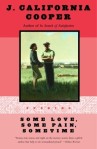
J. California CooperDate Read: December 26th 2015

Published: 1996

Publisher: Anchor Books / Doubleday

Pages: 273


The Blurb

Whether through her stories or her legendary readings, J. California Cooper has an uncanny ability to reach out to readers like an old and dear friend. Her characters are plain-spoken and direct: simple people for whom life, despite its ever-present struggles, is always worth the journey.

In Some Love, Some Pain, Sometime, Cooper’s characteristic themes of romance, heartbreak, struggle and faith resonate. We meet Darlin, a self-proclaimed femme fatale who uses her wiles to try to find a husband; MLee, whose life seems to be coming to an end at the age of forty until she decides to set out and see if she can make a new life for herself; Kissy and Buddy, both trying and failing to find them until they finally meet each other; and Aberdeen, whose daughter Uniqua shows her how to educate herself and move up in the world.

These characters and others offer inspiration, laughter, instruction and pure enjoyment in what is one of J. California Cooper’s finest story collections.

Review โ€“ โ˜…โ˜…โ˜… (3 stars)

I discovered J. California Cooper back in 2013. But the announcement of her passing in 2014 had me wishing I’d read her work earlier. After readingย Some Love, Some Pain, Sometime, I realized I had really been missing out on Ms. Cooper’s yummy ways of storytelling! As I was reading the stories in this collection, I felt as if I was chatting with a good friend in my living room. Cooperโ€™s stories have a juicy, gossipy-feel that make for an exciting, yet comforting read!

My favorite stories were:

‘Femme Fatale’ย – In this story, readers are invited into Darlin’s life as she tries to find herself. After losing both parents and her beloved grandmother, Darlin does all she can to be happy and to be loved by a good man, while in the process grooming herself to be a ‘femme fatale’.ย This story was an emotional rollercoaster and I loved how it ended. J. California Cooper puts a lot of sass into this story!

‘Sure Is a Shame’ย 

You know, it’s a fact and I seen it, sometimes when you think you taking a bite out of life, chewing hard on it, life be done taken a bite out of you and done already swallowed. Sho is a shame, sho isย (pg. 159).ย 

This is a cautionary tale on the consequences ofย taking the little things and good people for granted. It was a long-winded story, but also a wake up call and good reminder to appreciate each day in life, as well as the people placed in it.

Most of the characters inย Some Love, Some Pain, Sometimeย are either 50 years and older or they grow well into old age as they recollect different events of their lives.ย All the stories have an element of self-help to them, as J. California Cooper drops lots of wisdom on how to live a fulfilling life, through the characters in the stories. But I wished some of the protagonists were younger and that there was more variety to the stories in this collection. Honestly, I can only remember about 3 stories out of this collection. I found the rest of the stories redundant, predictable and quite simple – without much depth. With that said, I still look forward to reading some of J. California Cooper’s full novels – like Family and The Wake of The Windย in the near future. Definitely read this if you’re in the mood for a chatty, comforting collection of stories!

โ˜…โ˜…โ˜… (3 stars) โ€“ Good book. I recommend it, I guess.

IMG_4552

Purchaseย Some Love, Some Pain, Sometime onย Amazon


Letter to My Daughter (ebook) by Maya Angelou
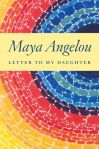
Letter_to_My_DaughterDate Read: November 27th 2015

Published: September 2008

Publisher: Random House

Pages: 166


The Blurb

Dedicated to the daughter she never had but sees all around her, Letter to My Daughter reveals Maya Angelouโ€™s path to living well and living a life with meaning. Told in her own inimitable style, this book transcends genres and categories: guidebook, memoir, poetry, and pure delight.

Here in short spellbinding essays are glimpses of the tumultuous life that led Angelou to an exalted place in American letters and taught her lessons in compassion and fortitude: how she was brought up by her indomitable grandmother in segregated Arkansas, taken in at thirteen by her more worldly and less religious mother, and grew to be an awkward, six-foot-tall teenager whose first experience of loveless sex paradoxically left her with her greatest gift, a son.

Whether she is recalling such lost friends as Coretta Scott King and Ossie Davis, extolling honesty, decrying vulgarity, explaining why becoming a Christian is a โ€œlifelong endeavor,โ€ or simply singing the praises of a meal of red riceโ€“Maya Angelou writes from the heart to millions of women she considers her extended family.

Like the rest of her remarkable work, Letter to My Daughter entertains and teaches; it is a book to cherish, savor, re-read, and share.

Review โ€“โ˜…โ˜…โ˜…โ˜… (4 stars)

Maya Angelou is one of the writers who got me truly interested in African-American literature and reading in general, back when I was 13 years old. When I was younger, I wasn’t particularly excited about the ‘classics’ I was forced to read, like – Black Beauty, David Copperfield, Oliver Twist, To Kill A Mockingbird, Little Women, The Catcher in the Rye,ย Ann of Green Gables, just to name a few. I appreciated those books, but I didn’t deeply connect with the characters of the novels. When my mother suggested for me to start reading Maya Angelou’s autobiography series which she owned in her bookshelf (my mother is an original bookworm. Me and my siblings will inherit a whooole library of books!), I started with –ย I Know Why The Caged Bird Sings. Angelou’s storytelling grasps all of your attention with her vivid descriptions, poetic writing style and punches of wisdom in each chapter of her work. *sigh* I’m still bitter that she passed away on my birthday in 2014. I really wanted to meet her or just be in her presence at a literary event.

Letter to My Daughter is my sixth read from Maya Angelou’s work and I believe it’s a timeless gem of essays!

My favorite essays were:

‘Accident, Coincident, or Answered Prayer’ – This story was very familiar, as I’ve read a similar version of the account in Angelou’s final book in her autobiography series – Mom & Me & Momย (2013). In ‘Accident, Coincident, or Answered Prayer,’ย Maya Angelou takes readers back to when she dated a physically abusive man and the (emotional, physical) pain it caused her life as a young woman. To think Angelou could have died in the serious brawl she describes in this essay is horrifying. However her fierce mother – Vivian Baxter, is the real MVP of this account as her love and fearless nature save Angelou. In this account, readers ultimately learn that Maya Angelou believed in the power of prayer.

‘Violence’

Too many sociologist and social scientists have declared that the act of rape is not a sexual act at all, but rather a need to feel powerful… The sounds of the premeditated rape, the grunts and gurgles, the sputtering and spitting, which commences when the predator spots and then targets the victim, is sexual. The stalking becomes, in the rapist’s mind, a private courtship, where the courted is unaware of her suitor, but the suitor is obsessed with the object of desire. He follows, observes, and is the excited protagonist in his sexual drama… I am concerned that the pundits, who wish to shape our thinking and, subsequently, our laws, too often make rape an acceptable and even explainable social occurrence… We must call the ravening act of rape, the bloody, heart-stopping, breath-snatching, bone-crushing act of violence, which it is. The threat makes some female and male victims unable to open their front doors, unable to venture into streets in which they grew up, unable to trust other human beings and even themselves. Let us call it a violent unredeemable sexual act… (pages 39-41).

This is an excerpt from ‘Violence,’ย one of the powerful (and self-explanatory) essays from this collection which is ever so relevant to us today in 2016. I wonder what Maya Angelou would make of the several, deeply upsetting rape cases that seem to be pushed under the rug today – especially the terrible Stanford rape case. Angelou picks readers’ brains and questions society’s complacency in combatting violent acts against women. This was a compelling, necessary essay.

Mother Maya Angelou can do no wrong in my eyes! This collection of essays is uplifting and familiar if you’ve read any of her autobiographies. Even if you aren’t familiar with her work, this is nevertheless a riveting collection to start with, as readers can get a feel of her storytelling, essays and poetry. Maya Angelouย was a well of wisdom who touched many lives through her wonderful words – she will always be one of my favorites!

P.S: Has anyone seen the Maya Angelou Documentary yet –ย Maya Angelou: And Still I Riseย ? It was released June 7th of this year!

โ˜…โ˜…โ˜…โ˜… (4 stars) โ€“ Great book. Highly recommend!

IMG_4553

I hope to purchase the physical copy ofย Letter to My Daughter soon!ย Above is my Mom’s super old Maya Angelou collection from our personal library. I have two books left to read from this pile ๐Ÿ™‚

Purchase Letter to My Daughter by Maya Angelou on Amazon
The Star Side of Bird Hill by Naomi Jackson

Date Read: June 14th 2016

Published: 2015

Publisher: Penguin Press

Pages: 304

The Star Side of Bird Hill

The Blurb

After their mother can no longer care for them, young Phaedra and her older sister, Dionne, are exiled from Brooklyn to Bird Hill in Barbados to live with their grandmother Hyacinth, a midwife and practitioner of the local spiritual practice of obeah.

Dionne spends the summer in search of love, testing her grandmother’s limits, and wanting to go home. Phaedra explores Bird Hill, where her family has lived for generations, accompanies her grandmother in her role as a midwife, and investigates their mother’s mysterious life.

When the father they barely know comes to Bird Hill to reclaim his daughters, both Phaedra and Dionne must choose between the Brooklyn they once knew and loved or the Barbados of their family.

โ—Šโ—Š

Review โ€“ โ˜…โ˜…โ˜… (3 stars)

I bought The Star Side of Bird Hill late last year for 2 reasons: I absolutely adored the super chic, sassy cover art (designed by an amazing contemporary Caribbean artist from Barbados – Sheena Rose) and I just had to support Naomi Jackson, as she’s an alum of Williams College – Middlebury’s (my alma mater) sister liberal arts school!

The Star Side of Bird Hill is a decent coming-of-age story that focuses on Barbadian-American sisters – Dionne (16 years old) and Phaedra (10 years old) as they learn new things about their family, culture and even themselves during their summer vacation in Bird Hill, Barbados. I really appreciated Jackson’s easy-going and descriptive writing style in this novel. Her vivid descriptions of Barbados definitely made this a great summer read! I felt as if I was with the characters during the lively carnival and on the sandy, pristine beaches against the backdrop of the serene sunsets. I could even hear the voices of both Dionne and Phaedra during their dialogues – that’s how thorough Jackson’s descriptions were!

But I kept wondering if The Star Side of Bird Hill was considered a YA (Young Adult) novel because it was surprisingly a heavy read. Tough issues like depression, mental illness, death, divorce, suicide, homosexuality, bi-cultural upbringing, Christianity, voodoo etc are all tackled in this book. I must say, Dionne and Phaedra’s grandma – Hyacinth, is the real MVP of this novel. I was in awe of her strength, courage and emotional stability given the series of unexpected, unfortunate incidents that occur at Bird Hill. It seemed as if Naomi Jackson was paying homage to the women of Bird Hill by showcasing the amazing strength the Barbadian women possess.

While reading, I sensed some similarities in this storyline to Haitian writer,  Edwidge Danticat’s novel Breath, Eyes, Memory – even though Danticat takes the themes of mother-daughter relationships, depression, sexual assault and suicide up a notch! I wanted to gift one of my friends who is of Grenadian heritage with this book, as I initially thought she’d easily relate to Caribbean/Caribbean-American storyline, but I’ve been having second thoughts since the story becomes super depressing for a good 100 pages. I wasn’t really blown away by The Star Side of Bird Hill when I finished the book. I enjoyed how most incidents and issues were sort of resolved by the end, but The Star Side of Bird Hill is not more than 3.5 stars for me. I do look forward to whatever Naomi Jackson writes next though!

โ˜…โ˜…โ˜… (3 stars) โ€“ Good book. I recommend it, I guess.

IMG_4282

Purchase The Star Side of Bird Hill on Amazon

We Are All Blue by Donald Molosi

Date Read: July 5th 2016

Published: 2015

Publisher: The Mantle

Pages: 128

We Are All Blue

The Blurb

We Are All Blue (Botswana) is a collection of two plays โ€“ Blue, Black and White & Motswana: Africa, Dream Again โ€“ by the actor and playwright Donald Molosi, including an introduction by Quett Masire, former president of Botswana.

Blue, Black and White (2011), the longest running one-man show in Botswanaโ€™s history, was the first-ever Botswana play staged off-Broadway in New York City, where Molosi won a best actor award. BBW is about the countryโ€™s first democratically-elected president, Sir Seretse Khama, and his interracial, transformative marriage. Winner of several awards, the play has been performed around the world.

Motswana: Africa, Dream Again is the story of Botswana and its people as they transition from a British colony to an independent state. The play premiered off-Broadway in 2012 where it won an award at the United Solo Festival, the worldโ€™s largest solo theatre festival. Written, directed, and performed by Molosi, the play has been performed across the U.S. and is on tour in Botswana and South Africa.

โ—Šโ—Š

Review โ€“โ˜…โ˜…โ˜…โ˜… (4 stars)

Donald Molosi is a brilliant playwright. What better way to learn about Botswana than by reading a play? The last time I read a play set in Africa was Ola Rotimi’s Our Husband Has Gone Mad Again, back in high school. Reading We Are All Blue was refreshing and I learned a GREAT deal about Botswana from this creative collection of two short plays.

The first play entitled, Blue, Black & White takes readers to a classroom, where young students are learning about pre-independence Botswana (or Bechuanaland, as the British called it) and Botswana’s founding father – Sir Seretse Khama’s controversial marriage to his British wife, Ruth Williams. The title of this play is actually the colors of Botswana’s flag: blue represents water, which is considered the lifeline of the desert nation; black represents the majority black population; the white strips represent the white citizens with whom the Motswana want to live in harmony with.

Botswana

Botswana’s blue, black and white National flag

The play simultaneously educates the students in their classroom as well as the reader of the Khama love story, Botswana’s road to independence and the importance of being inclusive as an African nation. I found this play to be oh soo cute! I loved all the characters (students) and the side conversations they had with their annoyingly domineering teacher.

Reading about history can be boring and tedious. But this play definitely informs Motswana (Motswana – citizen of Botswana) and others – both of African and non-African descent, on some facts about Botswana’s first president and the challenges the nation overcame in order to be as inclusive of all people as possible. The film – A United Kingdom directed by Amma Asante (yes, the Ghanaian-Brit film director!) based on Sir Seretse Khama and Lady Ruth’s disputed interracial romance, has been selected to open the 60th BFI London Film Festival in October! It should be showing in cinemas by November. I will definitely keep an eye out for that!

The second play entitled, Motswana: Africa, Dream Again is essentially a play on what it means to be Motswana (again, Motswana means, a citizen of Botswana). In this play, the protagonist – Boemo, is sooo woke! Boemo is a thirty year old member of parliament who seems annoyingly conscious (to everyone else) of his identity as Motswana and as an African. As a child of the new generation, he identifies more with being Pan-African than identifying solely as Motswana,

My mind and my knowledge of myself are formed by the victories that are the jewels in our African crowns, the victories we earned from Lagos to Juba, from Dimawe to Sophiatown, as the Ashanti of Ghana as the Berbers of the Sahara, as the Swahili of Tanganyika. Being part of all these people, and in the knowledge that none dare contest that assertion, I shall claim that I am African. And I am a Motswana (page 80).

Motswana: Africa, Dream Again is super short and straight to the point in its criticisms and depiction of post-colonial Botswana and what it means to call yourself an African today. I truly appreciate the Pan-African nature of this play. It erases the borders the colonial masters drew around us and simply articulates the importance of celebrating all African nationalities and identities – be it Namibian, Ugandan, Chadian, Ethiopian, Burkinabรฉ, Moroccan or Africans from the diaspora – as ONE,

I want to believe that a common ancestry is what binds us as Africans. I often imagine a common ancestor holding all Africans fiercely and warmly inside her womb… (page 96).

I always thought my first read from Botswana would be by Bessie Head, but Donald Molosi beat her to it! I’m eager to see Molosi perform live on stage one day, as he’s primarily an actor. I especially love that he got his undergrad degrees (in Political Science and Theatre) from Williams College – Middlebury’s (my alma mater) sister liberal arts school! So many young people of African descent doing amazing things. Read We Are All Blue if you want to enjoy a collection of entertaining, historical plays on Botswana and on Africa as a whole. This collection is inspiring.

โ˜…โ˜…โ˜…โ˜… (4 stars) โ€“ Great book. Highly recommend!

Purchase We Are All Blue on Amazon 


This review is in collaboration with the 2016 Writivism Festival in Kampala, Uganda (August 22nd – 28th 2016). I’d like to give a special thank you to Bwesigye Bwa Mwesigire and the crew over at #Writivism2016 for sending me an e-copy of We Are All Blue.๐Ÿ™‚

Brunch Over Books – Sip ‘n’ Swap in Accra!

Ever since I moved to Accra in 2014, I’ve really been missing the variety of literary events I used to attend back in Boston and Middlebury. But Accra has its own selection of events I’ve been enjoying. Writers Project Ghana has been spearheading the literary scene with the plethora of events they host, like – Ghana Voices Series: where bookworms and literary fiends gather for monthly public book readings featuring African writers who visit Accra; Writers Project on Citi FM: an hour of poetry readings and updates on literature-related events in Accra on the radio waves; writers workshops, book club meetings and more! With respect to book festivals, GAWBOFEST – Ghana Association of Writers Book Festival has been a recurring book festival for 5 years now. Hopefully I’ll find time to finally attend this year’s event in September. Also later this year, the Storymoja Festival will be in Accra (not Nairobi, Kenya) – so that will be exciting!

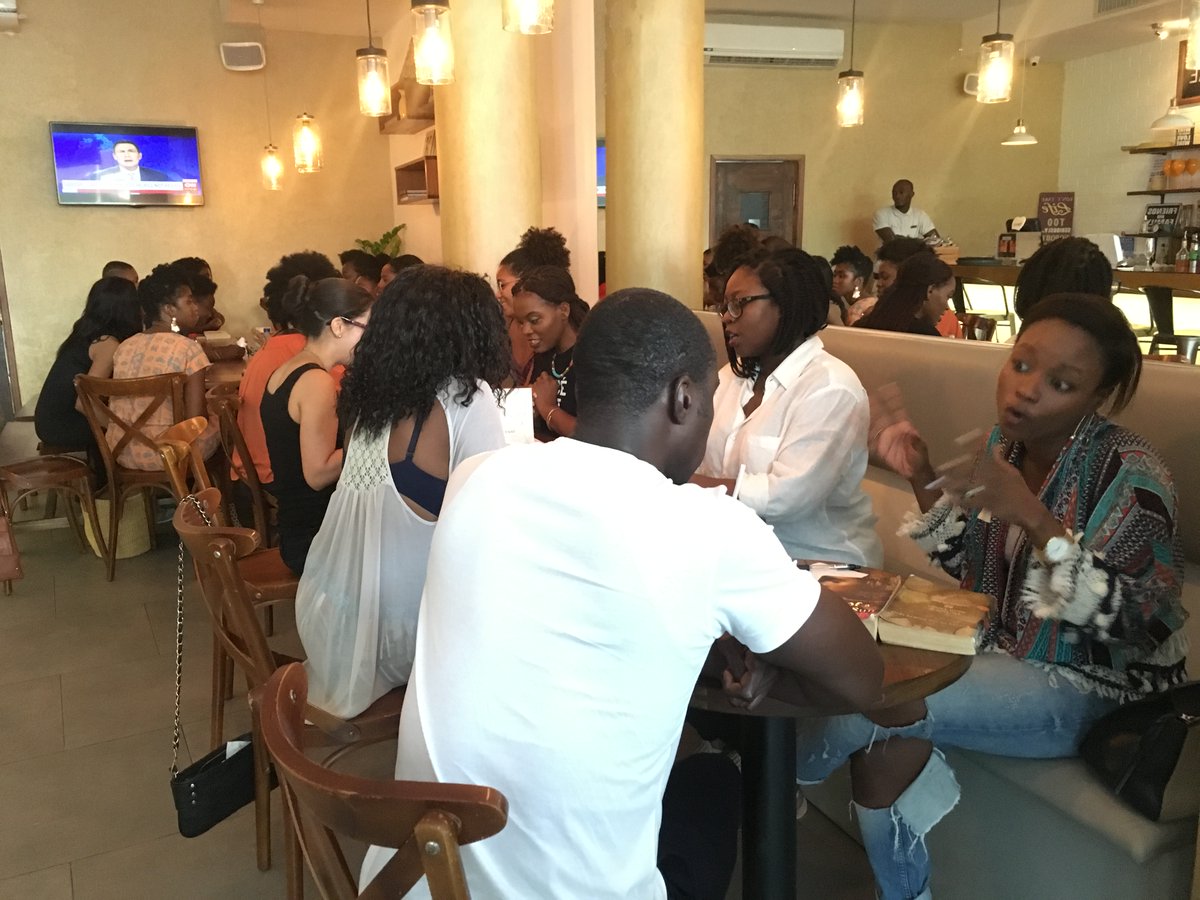
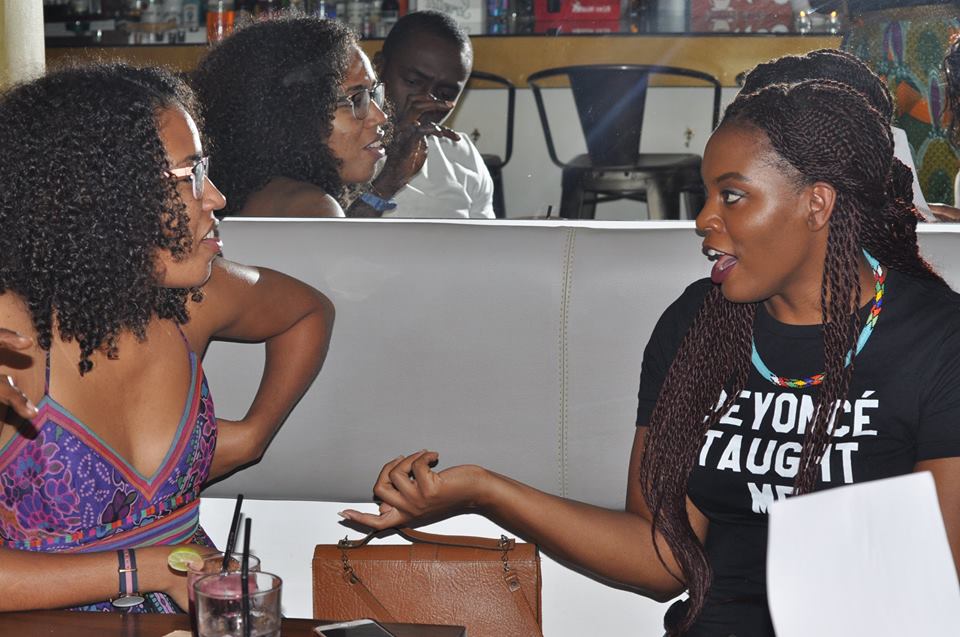
To add to the eclectic and ever growing bunch of literary events in Accra is – Brunch Over Books! Two weeks ago, Brunch Over Books – a Sip ‘n’ Swap book exchange was inaugurated at the quaint Cafรฉ Kwae, in Accra. This maiden event, curated by the lovely Nana Konamah (@nanakonamah), attracted lots of bookworms, book bloggers and page slayers to sip yummy drinks and exchange book titles and actual books! After a speed book exchange activity, I jotted down a couple of book recommendations, met some folks I had been following (or stalking) on social media – like Ghanaian bibliophile, Shika of @bookpress on Instagram (@bookpresse on Twitter) and just geeked-out over books with fellow book lovers who also recently moved to the city, and long time residents of Accra!

Images via Brunch Over Books

As per my Book Chat post on book lending – you know me! I do not lend or exchange books (sorry, not sorry). So for this event, I purposely purchased a new copy of Beyond the Horizon by Amma Darko (a Ghanaian book and author I believe is seriously underrated) for whoever wanted to swap with me – but for the person to KEEP.

Its always refreshing when you can converse with book lovers and discuss why you loved/disliked certain novels. If you live in Accra, try and come to the next Sip ‘n’ Swap event! Rumor has it that the next gathering will be in August. I can’t wait to see what new activities and conversations we’ll have over yummy cocktails.

What type of literary events do you usually attend? Have you ever been to any book festivals, public readings (I feel like public readings are standard go-to’s for book lovers, right?), book signings, book exchanges, book blogger meet-ups? How many times a year do you attend literary events? Please do share!

#SummerReads 2016 – TBR


IMG_4111

Hey everyone! Summer break is finally here and there are a couple of books I’d like to read before the end of the break. 7 books on my Summer TBR (to-be-read list) – too many books, or nah?

Please click on the titles below to read more about the books on Goodreads.

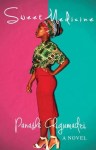
sweet medicineSweet Medicine by Panashe Chigumadzi 

Sweet Medicine is a book I had been trying so hard to get my hands on. I even double ordered it – by mistake, but I don’t regret it. One thing that drew me to this book was the chic book cover and the fact that Panashe Chigumadzi is only 25 and is doing amazing things for the continent! I finished Sweet Medicine about a week ago and it was an enjoyable read. Expect the review to go up at some point during the summer.


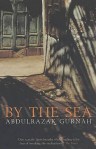
By the seaBy The Sea by Abdulrazak Gurnah

I saw a review of By The Sea on fellow book blogger (and one of my faves!) – Mary Okeke’s book blog some years back and added it to my TBR. This story is set in Zanzibar, Tanzania – a place I REALLY would love to visit one day! From a series of Goodreads reviews I’ve seen, I hear its best to read this slowly to fully get the impact of the story. I plan on doing exactly that!


The Star Side of Bird HillThe Star Side of Bird Hill by Naomi Jackson

The Star Side of Bird Hill may look familiar to some of you, as its been featured on quite a few of my posts – 2015 New Releases To Anticipate & the TBR Book Tag. Don’t you just love the book cover? Super sassy! Jackson actually wrote a piece about the book cover on the Literary Hub last year. I actually finished The Star Side of Bird Hill earlier this June. Expect a review soon!


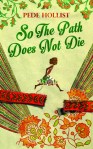
pede hollistSo The Path Does Not Die by Pede Hollist

The first time I heard about Pede Hollist was back in 2013, when he was shortlisted for the Caine Prize for African Writing. So The Path Does Not Die was published back in 2014 and follows a young girl, Finaba (or Fina) from Sierra Leone. I haven’t read much from Sierra Leone, so I hope to learn a thing or two about the West African nation from this novel!


The justiceThe Justice: A Political Thriller by Boakyewaa Glover

Boakyewaa Glover was kind enough to gift me with this book, along with her sci-fi novel – Tendai (which I read and really enjoyed back in May – expect a review soon!). I’ve been looking forward to reading The Justice since the beginning of the year. I’m excited to read this political thriller ๐Ÿ™‚


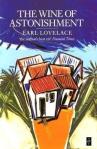
Earl LovelaceThe Wine of Astonishment by Earl Lovelace

I’m sure this book looks familiar to some of you. The Wine of Astonishment was featured in my 2015 Summer Book Haul. I hope I get a chance to finally read it this summer, as I hear its a Trinidadian classic!


born-on-a-tuesdayBorn on a Tuesday by Elnathan John

I purchased Born on a Tuesday back in March, after attending a reading by Elnathan John here in Accra. Elnathan John was also shortlisted for the Caine Prize for African Writing – in 2013 and 2015. I really like Elnathan John’s writing (his satire blog is quite hilarious. Check out his blog: Elnathan’s Dark Cornerhere). I prefer this vibrant book cover by Cassava Press. The book covers for the American and British editions aren’t appealing to me at all. I like this Nigerian cover ๐Ÿ™‚


We Are All BlueWe Are All Blue by Donald Molosi

In collaboration with the Writivism Book festival taking place in Kampala, Uganda – August 22-28, I shall be posting a review of We Are All Blue by Donald Molosi! This book was on my 2016 New Releases To Anticipate post. I’m especially excited that We Are All Blue is a collection of 2 plays that take place in Botswana. Indulging in a playwright from a country I’m not familiar with will be fun. Stay tuned for the review ๐Ÿ™‚


 Last year I was able to knockout 8 books during the summer break. I’m not sure I’ll be able to read all 7 of these books before the end of the summer – as I don’t plan on reading my break away. We’ll see! If these aren’t read by the end of the summer, hopefully they’ll be read by the end of the year – no pressure here (its not that serious).

IMG_4080

Have you read any of these? What books are on your Summer TBR? Please share some of your summer reads! New recommendations are always welcome ๐Ÿ™‚

And the 2016 Caine Prize winner isโ€ฆ

Yes, it’s that time of year again! In about two weeks, the 2016 Caine Prize winner will be announced!

For those who are not familiar, the Caine Prize for African Writing, which was first awarded in 2000 is an award โ€œopen to writers from anywhere in Africa for work published in English. Its focus is on the short story, reflecting the contemporary development of the African story-telling traditionโ€ (source).

Some notable winners of the Caine Prize include (click on links to my reviews):

  • Leila Aboulela, from Sudan (2000) โ€“ author of novels Minaret, The Translator, Lyrics Alley among other works. 
  • Binyavanga Wainaina, from Kenya (2002) โ€“ founding editor of Kwani?, author of memoir One Day I Will Write About This Place and the essay How To Write About Africa found in various literary magazines.
  • Yvonne A. Owuor, from Kenya (2003) โ€“ author of the novel, Dust.
  • E.C Osondu, from Nigeria (2009) โ€“ author of the novel, Voice of America: stories.
  • NoViolet Bulawayo, from Zimbabwe (2011) โ€“ author of the novel, We Need New Names

Previously shortlisted authors include: Mia Couto from Mozambique (2001), Chimamanda Adichie from Nigeria (2002), Laila Lalami from Morocco (2006), Chinelo Okparanta from Nigeria (2013), Tendai Huchu from Zimbabwe (2014), Elnathan John from Nigeria (2013 & 2015), among others!

The Caine Prize and its shortlisted stories play a huge role in the authors I read from the continent. Many Caine Prize winners and shortlisted writers have found great success and I’ve reviewed a good number of these writers’ works here on African Book Addict!


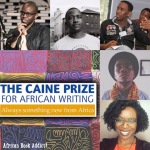
This year, the Caine Prize shortlist comprises of five talented young writers with unique short stories (top left to bottom right):

IMG_4122

(Images via caineprize.com ; collage created by African Book Addict!)

Tope Folarin (Nigeria) – Read his short story: Genesis

Bongani Kona (Zimbabwe) – Read his short story: At Your Requiem

Abdul Adan (Somalia/Kenya) – Read his short story: The Lifebloom Gift

Lidudumalingani (South Africa) – Read his short story: Memories We Lost 

Lesley Nneka Arimah (Nigeria) – Read her short story: What It Means When A Man Falls From The Sky

I was surprised to see Tope Folarin shortlisted AGAIN, since he won the Caine Prize back in 2013 for his moving story – Miracle. Why does the Caine Prize always shortlist past shortlistees and winners? Every year, many writers submit stories in hopes of being shortlisted – they couldn’t give someone else a chance to compete to win?

Anyways, Folarin’s Genesis reminded me of his Africa39 story, New MomGenesis is a semi-autobiographical story on Folarin’s family – more specifically on his mother’s mental illness and how it affected him as a child. Genesis made me uncomfortable. I felt stressed reading the story as Folarin freely shares with the world his mother’s plight. The story is an easy read and quite engrossing which I expected, since Folarin’s strength is in his ability to write moving stories – as seen in Miracle. I appreciate Folarin shedding light on mental illness and depression – topics we Africans usually shy away from. But for some reason, I’m not okay with his mother’s illness and antics being shared with the world (MY opinion!). If he wins the Caine Prize again, I anticipate some uproar from readers and critics.

Lesley Nneka Arimah’s story, What It Means When A Man Falls From The Sky was an engaging story. This is a story about Nneoma who is a Mathematician that can detect grief and sadness from fellow Nigerians and has the power to heal them. She seems to be searching to find the next genius mathematician to train with healing powers as well. The ending had me a bit confused… But this was an enjoyable read. I’m not a big fan of science fiction but I loved the afrofuturism vibes I got from this story!

Abdul Adan’s story The Lifebloom Gift is my favorite! This story is sooo bizarre. The Lifebloom Gift is a story about a TSA officer who has an encounter with Ted Lifebloom – a 30 year old man who seems to thrive off touching moles on other peoples’ bodies. Once Ted Lifebloom touches another person’s mole, the person he’s touching is transported into a land of “green pastures where they hear the song of birds and sneezes of horses, smell the fur of dogs, feel a twitch in one of their nipples which, in turn, transforms into a brown lactating nippleโ€ฆ” or in short, the person understands the meaning of love (whaaat?!). The TSA officer later conducts a case study on Ted Lifebloom and goes on an adventure to find other Lifebloomers, by accessing moles on the backs of potential Lifebloomers. The story starts off a bit confusing, as it’s hard to picture what Abdul Adan is describing. But as the story unfolds, it all starts to make sense even though its still very strange. It’s actually hard to explain this story. But it was hilarious to read and oh so weird! If you don’t read any of these stories at all, at least read The Lifebloom Gift! It’s truly an original and creative story. I hope Abdul Adan wins the 2016 Caine Prize!

Which story is your favorite? Who do you think will win the Caine Prize this year?

The winner will be announced on the 4th of July at the Weston Library, Oxford, England. Good luck to all the shortlisted candidates!

You can also check out my commentary on the Caine Prize from 2014 – here & 2015 – here :).