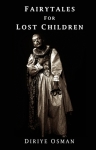
Fairytales For Lost Children by Diriye Osman

Date Read: January 7th 2016

Published: September 2013

Publisher: Team Angelica Press

Pages: 156

Diriye Osman

The Blurb

Fairytales For Lost Children is narrated by people constantly on the verge of self-revelation. These characters – young, gay and lesbian Somalis – must navigate the complexities of family, identity and the immigrant experience as they tumble towards freedom. Using a unique idiom rooted in hip-hop, graphic illustrations, Arabic calligraphy and folklore studded with Kiswahili and Somali slang, these stories mark the arrival of a singular new voice in contemporary fiction.

โ—Šโ—Š

Review โ€“ โ˜…โ˜…โ˜…โ˜…โ˜… (5 stars)

*sigh*

Is it too early to already know my favorite book of the year? Fairytales For Lost Children just might be the best book Iโ€™ve read this year. I read two stories a day from this collection, to adequately absorb everything in little bits. I even smoothed the velvet-textured book cover against my cheeks after reading some of the stories (no, Iโ€™m not a weirdo… maybe a little haha). And when I was done reading Fairytales For Lost Children, I wanted more. I need Diriye Osman to write a full novel soon!

This collection of short stories is raw, erotic, sassy, vivid, devastating and most importantly, liberating. These stories are set in modern day Somalia, Kenya and London. The characters of these stories just want to be loved for who they are. They desire to live their lives free from hate, criticism, and scrutiny, while trying to understand the intersectionalities of their own identities.

There are eleven stories in this collection and I loved how Diriye Osman precedes each story with his beautiful artwork, which visually summarizes each tale. Osman also incorporates lots of Neo-Soul (my ultimate favorite music genre) and old school Hip-Hop music into the stories. He refers to Meshell Ndegeocelloโ€™s 2002 soul album, Comfort Woman in about three of the stories, so I just had to purchase that album after I read this collection! Osman also blends languages like Somali, Arabic and Swahili into these stories, which make them feel authentic. I deeply enjoyed each and every one of the stories (which is rare for a short stories collection โ€“ there are always one or two stories I donโ€™t care for) but my faves were:

Shoga‘ โ€“ This tale was pretty explicit but entertaining and heartbreaking at the same time. A displaced seventeen year old Somali boy lives with his grandmother, Ayeeyo, in Kenya. He falls in love with Boniface – the domestic help who is a refugee from Burundi. After enjoying many nights of listening to Bob Marley, smoking marijuana and sleeping with Boniface in his quarters, this seventeen year old later has to deal with the consequences of his pleasures by facing his grandmother โ€“ before her time is up.

Earthling‘ โ€“ This is a story that follows Somali-Brit – Zeytun, who suffers from psychosis and deeply desires love from her family – more so, from her sister. Her only family and support system is her girlfriend, Mari, who admirably stands by Zeytun and aids in her mental and emotional healing. The love exhibited between this lesbian couple was eye-opening and comforting to me.

Your Silence Will Not Protect You‘ โ€“ This story is preceded by Diriye Osmanโ€™s artwork that actually looks like a portrait of himself (he’s the man on the book cover by the way!), so Iโ€™m assuming this tale is loosely based on his personal story. Osman boldly narrates the series of events that lead to him coming out to his family, and how he boldly deals with the pain of rejection.

The Other (Wo)man‘ โ€“ Iโ€™ve never read a story like this before. Yassin is a young, twenty-two year old Somali man living in London, pursuing his art degree and is ready to start dating. He meets a middle-aged, British-Jamaican man who works as an army pilot on a dating website (Gaydar) and they go on a couple of dates. But one night, Yassin realizes that the British-Jamaican man’s fetishes not only offend him, but actually push him to maybe trying something he never thought he’d consider. This coming-of-age tale had me sooo worried. But I loved observing Yassin as he strived to understand his ever evolving identities.

My favorite quote from ‘The Other (Wo)man‘ as Yassin takes a walk towards Peckham Rye:

He felt his sense of Somaliness slipping away from him and he was afraid of letting it go, afraid of the moral, psychological and social anarchy its loss threatened to create within him. But at the same time, what was he really hanging onto? A sense of social allegiance? But wouldn’t he be automatically excluded from his community because of his sexual orientation wherever his own allegiance lay? He didn’t belong to just one society: he was gay, Somali, Muslim, and yet all these cultural positions left him excluded… He was Somali first, Muslim second, gay third. But perhaps that hierarchy was only a matter of timing: born Somali, raised Muslim, discovered gay. And now he was venturing out into the world without a sense of his place within it and this frightened him. Yet he realized that he couldn’t mourn what was lost but instead had to consider what was to be gained. He knew he would never belong but did he really want to? (pg. 137)

This collection of short stories is probably the best LGBTQ-themed African fiction out there. I totally understand why Diriye Osman won The Polari First Book Prize back in 2014. Osmanโ€™s writing style is bold and fearless and I believe this collection is a priceless gem among the myriad of African fiction novels around. Please read this if you get the chance! And try not to judge the characters in the stories; just immerse yourself in the different happenings of the tales and learn from them. These stories speak volumes on being true to yourself, following your heart and the universal human need to love one another, regardless of sexual orientation, race, occupation, religion. Fairytales For Lost Children must have been liberating to write and I truly admire Diriye Osman as a storyteller and visual artist. Readers around the world will find solace in this work of art โ€“ I definitely did! I look forward to reading more of Osmanโ€™s work in the future. Iโ€™m sure whatever he writes next would be as fierce as this collection.

โ˜…โ˜…โ˜…โ˜…โ˜… (5 stars) โ€“ Amazing book, I loved it. Absolutely recommend!

IMG_3573
  • Also!! Read Diriye Osman’s essay published in The Huffington Post (2014): To Be Young, Gay and African
  • I really enjoyed this conversation between Diriye Osman and Another Africa, where they discuss Osman’s background, musical influences and his creative process, difficulties he faced in writing this collection, future projects and so much more!

Other Somali writers I plan on reading in the future (click on their names to check out their Goodreads profiles and their collection of work): Nuruddin FarahAyaan Hirsi Ali, Warsan Shire (Somali-British), Ladan Osman (Somali-American), Nadifa Mohamed (Somali-British).

Purchase Fairytales For Lost Children on Amazon

African Love Stories: An Anthology edited by Ama Ata Aidoo

Date Read: January 23rd 2016

Published: 2006

Publisher: Ayebia Publishing

Pages: 249

aidoo

The Blurb

African love stories? Is that not some kind of anomaly? This radical collection of short stories, most published in this edition for the first time, aims to debunk the myth about African women as impoverished helpless victims. With origins that span the continent, it combines budding writers with award-winning authors; the result is a melting pot of narratives from intriguing and informed perspectives.

These twenty odd tales deal with challenging themes and represent some of the most complex of love stories. Many are at once heart breaking yet heart warming and even courageous. In Badoe’s hilarious ‘The Rival’, we encounter a 14 -year-old girl who is determined to capture her uncle’s heart. His wife, she decided would just have to go. Mr. Mensah the uncle is all of sixty years old.

Crafted by a stellar cast of authors that includes El Saadawi, Ogundipe, Magona, Tadjo, Krog, Aboulela, Adichie, Oyeyemi, wa Goro, Atta, Manyika and Baingana, there is hardly any aspect of women’s love life untouched. From labour pains to burials, teenagers to octogenarians, and not to mention race-fraught and same-sex relationships, the human heart is all out there: beleaguered and bleeding, or bold, and occasionally triumphant.

โ—Šโ—Š

Review – โ˜…โ˜…โ˜…โ˜…โ˜… (5 stars)

I think I have a soft spot for anthologies. Anthologies help me discover new writers. African Love Stories: An Anthology is the second African womenโ€™s anthology Iโ€™ve enjoyed. In 2014, I reviewed Opening Spaces: Contemporary African Womenโ€™s Writing edited by Yvonne Vera (1999) and was thrilled by the diverse stories and cast of African women writers. I even took interest in the writers who were unfamiliar to me at the time, like Leila Aboulela and Lรญlia Momplรฉ.

I know what you were thinking when you saw the title, โ€˜African Love Storiesโ€™ – no, this is not a collection of sappy, romantic, unrealistic, happily-ever-after tales. African Love Stories: An Anthology is a collection of 21 contemporary short stories laden with breathtaking originality. The stories speak on: the issues inter-racial couples face, a womanโ€™s wrath when she discovers her lover is married, the lengths a village boy goes to rescue his wife-to-be, domestic violence, a child born out-of-wedlock who is scorned at her fatherโ€™s funeral, same-sex relationships, sisterhood, a motherโ€™s love, sacrifice and so much more. There are layered complexities in all 21 stories and the writers skillfully consummate each short tale such that readers ponder and cherish them, even days after enjoying the stories.

The women writers and the stories of this anthology span across the African continent โ€“ from Egypt to South Africa. Well-known authors such as: Nawal El Saadawi, Veronique Tadjo, Chimamanda N. Adichie, Leila Aboulela, Sindiwe Magona, Sefi Atta, Monica Arac de Nyeko, Helen Oyeyemi amongst others, are featured in the anthology. But I expected more diversity with respect to the countries represented in this collection. I didnโ€™t expect a lot of the stories (11 of them) to be written by Nigerian women – this is not a bad thing, donโ€™t get me wrong! I just wish there was a better mix of countries represented, as was in Opening Spaces: Contemporary African Womenโ€™s Writing edited by Yvonne Vera (1999). (Iโ€™m not comparingโ€ฆ but Iโ€™m comparing haha)

Anyways, I enjoyed all the stories from this collection (well, except two) and my faves were:

“Something Old, Something New” by Leila Aboulela (Sudan) โ€“ This is a story that chronicles the events that occur prior to a wedding between a young, muslim, dark-skinned Sudanese woman of the diaspora and a white, muslim man from Edinburgh. During their trip to Khartoum for the ceremony, several events occur that threaten their impending wedding. I really admire the calm manner of Aboulela’s storytelling, especially in this tale.

“The Rival” by Yaba Badoe (Ghana) โ€“ The Rival has got to be the most absurd story Iโ€™ve ever read! In this story, a wife tries her best to keep her marriage from falling apart by the twisted, affectionate love of her husbandโ€™s niece. Since when did nieces start falling for their uncles and dreaming of being the โ€˜madamโ€™ of the house? How awkward! Yaba Badoe created a masterpiece with this strange story.

“Tropical Fish” by Doreen Baingana (Uganda) โ€“ University student – Christine, finds herself sleeping with a British expat who exports fish to the UK. The story takes us through the inner thoughts of Christine as she tries to find herself โ€“ because she truly seems lost. I was disgusted and at times mad at Christine for tolerating the intolerable in this story. I loved how Doreen Baingana kept me on the edge of my seat while reading this! (I have Doreen Bainganaโ€™s novel Tropical Fish which this story is an excerpt from, and Iโ€™m excited to read it soon!)

“Needles of the Heart” by Promise Ogochukwu (Nigeria) โ€“ I enjoyed the easy, simple nature in the writing of this story. A woman marries a man who she discovers is a chronic abuser. She constantly finds herself making excuses for her husband, even while she suffers on hospital beds from his fury. The ending of the story had me wondering if the author actually condones domestic violence… This story is pretty scary, but holds a great message if you read in-between the lines.

The editor, Ama Ata Aidoo urges readers to enjoy this collection slowly:

Dear reader, it is highly recommended that you take these stories one at a time, so that you meet these African women properly and individually, and listen to them and their hearts: whether Sudanese, Kenyan, Ghanaian, Nigerian or Zimbabweanโ€ฆ (pg. xiv)

and I totally concur with her. I read these stories slowly and savored them. Why rush through such a rich anthology? Thatโ€™s no fun!

Even though this anthology was published in 2006 – about 10 years ago, I believe the content is ever so relevant to this day. I wholeheartedly recommend this collection to everyone. These contemporary stories may be set in countries in Africa, but the theme of love is universal to all!

โ˜…โ˜…โ˜…โ˜…โ˜… (5 stars) โ€“ Amazing book, I loved it. Absolutely recommend!

IMG_3007

Purchase African Love Stories: An Anthology on Amazon


GIVEAWAY ALERT!

February is the month of love, and Iโ€™d like to give away one brand new copy of this lovely anthology! Enter the giveaway below to stand a chance at winning African Love Stories: An Anthology. The winner will be announced a day after Valentineโ€™s Day โ€“ so you have about 10 days to try your luck!

a Rafflecopter giveaway

Giveaway TERMS & CONDITIONS:

  • Giveaway starts Feb 4th 2016 at 12am GMT & ends Feb 15th 2016 at 12am GMT (Greenwich Mean Time)
  • This is an international giveaway – it is open to everyone, worldwide.
  • You must be 18 years and older to participate in this giveaway.
  • The winner will be selected by Random.org, through Rafflecopter and will be notified by email.
  • The winner will have 48 hours to respond to the email before a new winner is selected.
  • If you are the lucky winner of the book, Darkowaa will be shipping your prize to you directly.
  • Once the winner is notified via email, providing shipping details will go to Darkowaa only and will only be used for the purpose of shipping the prize to the winner.
  • The item offered in this giveaway is free of charge, no purchase is necessary.
  • If there are any questions and concerns about this giveaway, please email: africanbookaddict@gmail.com

Good luck, everyone!

Update: This giveaway has ended. Thanks to those who participated! Congrats to the winner! 

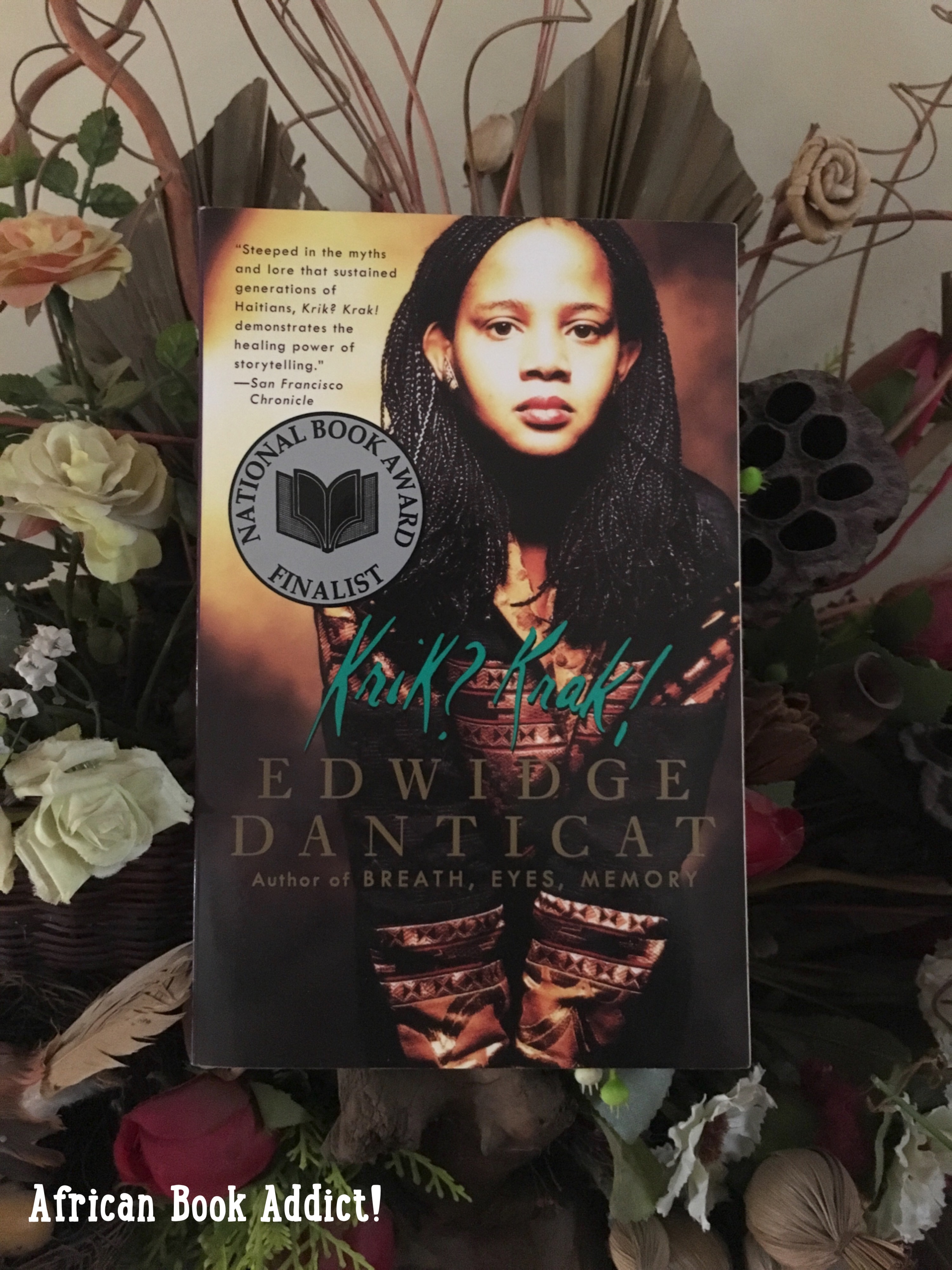
Krik? Krak! by Edwidge Danticat

Date Read: July 8th 2015

Published: 1996

Publisher: Vintage Books

Pages: 224

Edwidge Danticat

The Blurb

At an astonishingly young age, Edwidge Danticat has become one of our most celebrated new writers. She is an artist who evokes the wonder, terror, and heartache of her native Haiti โ€“ and the enduring strength of Haitiโ€™s women โ€“ with a vibrant imagery and narrative grace that bear witness to her peopleโ€™s suffereing and courage.

When Haitians tell a story, they say “Krik?” and the eager listeners answer “Krak!” In Krik? Krak!ย Danticat establishes herself as the latest heir to that narrative tradition with nine stories that encompass both the cruelties and the high ideals of Haitian life. They tell of women who continue loving behind prison walls and in the face of unfathomable loss; of a people who resist the brutality of their rulers through the powers of imagination. The result is a collection that outrages, saddens, and transports the reader with its sheer beauty.

โ—Šโ—Š

Review โ€“  โ˜…โ˜…โ˜…โ˜… (4 stars)

Reading Krik? Krak! was a pleasant experience! It was the perfect summer read, especially since most of the short stories in this collection take place in Haiti – the island with the indigo blue skies and the sandy beaches. It is very evident that Danticat wrote this collection from her heart and I felt her love for the island in every story. All nine stories have a calm nature to them and they read smoothly. These stories were truly engaging and I loved that they all seemed interconnected with one another and had some sort of realistic twist. Danticatโ€™s effortless talent in storytelling is wonderfully showcased in this collection and my favorite stories were:

Between the Pool and the Gardenias – This was a crazy story! A housemaid finds and keeps an abandoned baby and decides to name the baby, Rose. After a couple of days, she realizes that the baby is emitting a strong stenchโ€ฆbecause it is dead and rotting! This story startled me and I loved it.

The Missing Peace – This is a story about a precocious, brave, fourteen year old named ‘Lamort’ by her grandmother (‘Lamort’ means ‘death’ โ€“ because after she was born, her mother died. Quite eerie). I love how Lamort finds her own voice by the end of this story, grรขce ร  her forbidden friendship with an American journalist who visits the island.

Caroline’s Wedding – This was an interesting tale of a Haitian family residing in New York City. The adult daughters in this family โ€“ Gracina and Caroline, live with their widowed mother. Their mother is very bitter that her last child – Caroline (who was born without her left forearm) is marrying a Bahamian and not a Haitian. Meanwhile, as Gracina tries to placate her motherโ€™s resentment, she learns more about her parentsโ€™ marriage and starts to have strange dreams about her deceased father.

Epilogue: Women Like Us – This piece was a solid conclusion to the collection of stories. I’m assuming this was a true account on the struggles Danticat experienced in convincing her family of her desire to become a writer instead of the stereotypical housewife or cook most women in her family pride themselves and aspire to.

I learned a great deal about Haiti from this collection and Danticat expertly highlights the hardships Haiti has faced and how these trials have affected its citizens. I’m actually still researching things from the book to learn more, for example: the coup d’etats Haiti faced in 1988 and 1991, Papa Doc Duvalier (Haiti’s ex-president – Franรงois Duvalier) and his role in Haiti’s development etc. Krik? Krak! was an enlightening read from the diaspora and I will definitely be reading more of Danticat’s work soon. Edwidge Danticat’s books have been on my to-read list for a while now and I must say, fellow book blogger – Shannon from Reading Has Purpose (check out her book blog!), made me even more eager to indulge in Danticat’s work, as she is a huge fan and speaks highly of her novels! I think the next book I read by Danticat will be her first novel (1994), Eyes, Breath, Memory.

โ˜…โ˜…โ˜…โ˜… (4 stars) โ€“ Great book. Highly recommend!

Purchase Krik? Krak! from Amazon

And the 2015 Caine Prize winner isโ€ฆ Namwali Serpell!

A big congratulations to Zambia’s Namwali Serpell for winning the 2015 Caine Prize for African Writing!!

Namwali Serpell is the 16th winner of the Caine Prize, which is recognized as Africaโ€™s leading literary award for short stories. The winner was announced last night at a dinner held at the Weston Library, Oxford, England for all the shortlisted candidates.

Namwali Serpell won the ยฃ10,000 prize for her short story, โ€˜The Sackโ€™. Initially I was miffed at how this year’s shortlist was more or less a dichotomy between South Africa and Nigeria, with one story from Zambia. Even though I was more in love with Elnathan’s story ‘Flying‘, I’m happy Zambia won this for once! I look forward to more of Serpell’s work in the future. Her short story, ‘The Sack’ can also be found in the Africa39 anthology which was published in October of last year (2014). Check out Africa39 to read more new short stories by young African writers, under the age of 39!

Namwali Serpell winner

 Read โ€˜The Sackโ€™ by Namwali Serpell – here

And the 2015 Caine Prize winner isโ€ฆ

Its that time of year again! In about two weeks, the 2015 Caine Prize winner will be announced!

For those who are not familiar, the Caine Prize for African Writing, which was first awarded in 2000 is an award โ€œopen to writers from anywhere in Africa for work published in English. Its focus is on the short story, reflecting the contemporary development of the African story-telling traditionโ€ (source).

Some notable winners of the Caine Prize include:

  • Leila Aboulela, from Sudan (2000)โ€“ author of novels Minaret, Lyrics Alley amongst other works. 
  • Binyavanga Wainaina, from Kenya (2002)โ€“ founding editor of Kwani?, author of novel, One Day I Will Write About This Place and the essay โ€œHow To Write About Africaโ€ found in various literary magazines.
  • Yvonne A. Owuor, from Kenya (2003)โ€“ author of the novel, Dust.
  • E.C Osondu, from Nigeria (2009) โ€“ author of the novel, Voice of America: stories.
  • NoViolet Bulawayo, from Zimbabwe (2011) โ€“ author of the novel, We Need New Names

This year, the Caine Prize shortlist comprises of five talented young writers with unique short stories (left to right):

caine prize for african writing 2015
  • Elnathan John (Nigeria) for โ€œFlyingโ€ in Per Contra (Per Contra, International, 2014)
    Shortlisted in 2013 for โ€œBayan Layiโ€
    Read “Flying”
  • Masande Ntshanga (South Africa) for โ€œSpaceโ€ in Twenty in 20 (Times Media, South Africa, 2014)
    Read “Space”
  • Namwali Serpell (Zambia) for โ€œThe Sackโ€ in Africa39 (Bloomsbury, London, 2014)
    Shortlisted in 2010 for โ€œMuzunguโ€
    Read “The Sack”
  • F. T. Kola (South Africa) for โ€œA Party for the Colonelโ€ in One Story (One Story, inc. Brooklyn, New York City, 2014)
    Read “A Party for the Colonel”
  • Segun Afolabi (Nigeria) for โ€œThe Folded Leafโ€ in Wasafiri (Wasafiri, London, 2014)
    Caine Prize winner 2005 for โ€œMonday Morningโ€
    Read “The Folded Leaf”

(The biographies for the shortlisted candidates can be found โ€“ here).

To be honest, I was a bit disappointed that this year’s countries shortlist was more of a dichotomy between Nigeria and South Africa. I expected a more diverse pool of stories to enjoy. But hey! Its the stories that matter, right?

I read Namwali Serpell’s story ‘The Sack‘, as it is one of the short stories in the Africa39 anthology that I own. I don’t know how I feel about her story…It’s a little confusing to me! From what I gather, the story is about the protagonist (I don’t know if this is a boy or girl) having nightmares about being killed, while the men he/she lives with use a young black orphan to go fishing and later debate whether the orphan should live with them or not. There also seems to be a feud between the men in the house, as one is elderly and seems to be sick and grumpy. Humph! If anyone has read the story and understands it, please do explain!

My favorite story so far is โ€˜Flyingโ€™ by Elnathan John. โ€˜Flyingโ€™ is how a short story should be: simple yet moving. The story is about Tachio โ€“ a JSS3 (9th grade) dorm leader of a refuge home/school, who believes he can fly once he falls asleep. This feeling of flying brings him peace and joy. He shares his joy of flying with his friend Samson, but is deemed mad. Once Tachio tells foul-mouthed Aunty Ketura, who is the founder of Kachiro Refuge Home, she appreciates his belief of flying and assumes Tachio was a bat, vulture or eagle in his past life. Since Tachio is the dorm leader, he frequently cleans Aunty Keturaโ€™s office and later finds the drawer where she keeps all the records of the boys and girls in the home. Finding out that some of his friends were initially found near trash cans, in market places and in toilets, makes Tachio (who was born in a hospital) feel like he has an edge over his classmates who have no idea of their origins. The story ends with the sudden death of Aunty Ketura, which shocks the whole school, especially Tachio. But the strange presence of a big brown chicken with a limp on their school compound gives Tachio solace, as he believes Aunty Ketura has been incarnated into this bird.

Elnathanโ€™s use of metaphors in comparing human appearances to animals gave the story some spice. I mostly appreciated how readers can get the full scope of Tachioโ€™s wavering feelings of being a dorm leader, wanting to be mischievous with his friends, to wanting to please Aunty Ketura, seeking advice and comfort from Aunty Ketura etc. Iโ€™m yet to read the last three stories on the shortlist, but โ€˜Flyingโ€™ is the most enjoyable story to me thus far. Itโ€™s simple, understandable and moving.

Which story is your favorite? Who do you think will win the Caine Prize this year?

The winner will be announced on the 6th of July at the Weston Library, Oxford, England. Good luck to all the shortlisted candidates!

Valentine’s Day Anthology 2015

VDA_COVER_FINAL_large

Happy Valentine’s Day, everyone!

Ankara Press gave us a special treat today, by publishing a Valentine’s Day anthology featuring 7 short stories by some great contemporary African writers. According to Ankara Press, this lovely collection shows that “romance can be empowering, entertaining, and elegantly written, by men as well as women.”

Some of the writers and readers of the stories include: Sarah Ladipo-Manyika, Eghosa Imasuen, Helene Cooper, Chuma Nwokolo and my favorite- Binyavanga Wainaina, amongst others!

The stories are written in English with some translations in Pidgin, Kiswahili, Yoruba, French, Kpelle, Igbo and Hausa languages. There are also audio versions of the stories in this anthology- such an awesome treat!

I’m enjoying all the stories thus far, I hope you all enjoy them too!

Read, listen and download (for free!) Valentine’s Day Anthology 2015HERE

To find out more about Ankara Press – A New Kind Of Romance, click – here or follow them on Twitter @ankarapress.

You Canโ€™t Keep A Good Woman Down by Alice Walker

Date Read: January 18th 2015

Published: 1981

Publisher: Harvest Books

Pages: 180

Alice Walker

The Blurb

A natural evolution from the earlier, much acclaimed short story collection In Love & Trouble, these fourteen provocative and often humorous stories show women oppressed but not defeated. No longer do they excuse the aggression of others, no longer are they suspended in their unhappy condition. The women here claim every bit of space they make.

These are modern stories: about love, lust, fame and cultural thievery, the perils of pornography, abortion and rape; the delight of new lovers, and the rediscovery of old friends, affirmed even across self-imposed color lines.

โ—Šโ—Š

Review – โ˜…โ˜…โ˜…โ˜…โ˜… (5 stars)

Lovely, lovely, lovely collection of 14 short stories. If you want to think and learn something new, this is a must-read! You Canโ€™t Keep A Good Woman Down is a classic. Most of the stories are pretty deep though. Alice Walker tackles issues from feminism/womanism to pornography to death to poverty to fame, abortion, the civil rights movement etc. All the women in these stories have some odds going against them, but find different ways of dealing with the prejudices. Even though these stories tug at your emotions, Walker ensures there are positive, humorous bits to all the stories allowing readers to see the light in the situations of each character in the stories.

I love how Walker makes references to Ida B. Wells, Audre Lorde and other prominent black women who have helped shape (black) American lives for the better. I also enjoyed Walkerโ€™s writing style in this collection. The sentence structures and style of writing leave room for various interpretations of her stories. When I re-read this, I will surely learn more things that I didn’t grasp from this first reading. Besides her critically acclaimed novel – The Color PurpleYou Can’t Keep A Good Woman Down is another great novel showcasing Alice Walker’s versatility as a writer.

Note: Prior knowledge on the Civil Rights Movement would help you thoroughly appreciate the stories in this book. Also, I think you must be 18 years or older to read this book – some descriptions are QUITE explicit!

My favorite stories were:

“How Did I Get Away With Killing One of the Biggest Lawyers in the State? It Was Easy” โ€“ This was a sad and crazy story from beginning to end. Some women are crazyโ€ฆand dangerous! Loved it.

“Coming Apart” – I think every married couple should read this story- together. It’s sooo deep! It has you thinking about sex in such a different, non-flippant way. I’ll have to read it again to fully understand the concepts discussed in the story, but I learned how pornography has terrible consequences in relationships/marriages.

“The Abortion” – I just felt sick to my stomach reading this story. There weren’t many gory descriptions, but it was just miserable. I think I resented the main character. She was a selfish woman and expected her husband to make her happy, when happiness is really from within.

“A Sudden Trip Home In The Spring” – After the death of her father, Sarah – who is the only black girl in her school, questions whether she is in the right school as she sometimes feels out of place. I loved the calmness of this story. Some bits reminded me of my undergraduate experience at Middlebury College.

Like I said, if you want to think and learn something new, read this!

Oh! Today- February 9th, is Alice Walker’s 71st birthday! Happy Birthday Alice Walker!

โ˜…โ˜…โ˜…โ˜…โ˜… (5 stars) โ€“ Amazing book, I loved it. Absolutely recommend!

Purchase You Can’t Keep A Good Woman Down on Amazon

Can We Talk and Other Stories by Shimmer Chinodya

Date Read: November 22nd 2014

Published: 2001 (originallyย published by Baobab Books in 1998)

Publisher: Heinemann (African Writers Series)

Pages: 154

shimmer

ย The Blurb

Opening with the puzzled and innocent view of a boy looking in on the adult world from outside, this collection follows the transition from childhood to adult life. Youthful desires for prosperity, love and a purpose in life are undermined by experiences of humiliation, compromise and a failure to communicate, in a process that reflects a wider disillusionment and decline in post-independence Zimbabwe. In the final story, cynicism turns to anger as the narrator, facing the breakdown of his marriage, challenges his audience to confront the inaction that leads to disappointment and the deep-seated loneliness and alienated at the root of our estrangements.

โ—Šโ—Š

Review – โ˜…โ˜…โ˜…โ˜… (4 stars)

This is a refreshing collection of 11 short stories and Iโ€™m glad I randomly spotted this at the bookstore! People, Chinua Achebe and Wole Soyinka are not the only legendary African Literature male novelists. Shimmer Chinodya is surely one of them- in my opinion! He is a wonderful poetic storyteller.

Can We Talk And Other Stories is a collection of stories that take readers through the transitions of boyhood to manhood. Various issues associated with coming-of-age such as confusion, fear, loneliness, depression, insecurity, alcoholism amongst others are tackled in these 11 short stories. It’s best to read these stories from the beginning to the end, as the stories are in chronological order with respect to the age of the main characters.

The novel starts off with a story of a precocious five year old boy, followed by tales of school life- in Zimbabwe and abroad, followed by stories of adult relationships and ends with a story of a forty-something year old man, lamenting his failed marriage called โ€œCan We Talkโ€. โ€œCan We Talkโ€ was actually nominated for The Caine Prize for African Writing in year 2000- the year Leila Aboulela won the prize for her story โ€œMuseumโ€.

I enjoyed all the stories, mostly because they were different from the myriad of West African novels I usually read. I loved reading about Zimbabwe and admired Chinodyaโ€™s use of Shona (the principle language of Zimbabwe) in the text. The glossary at the back of the novel helped me translate some of the words used in the text, but even without the glossary I was able to understand the ideas conveyed in the stories. Chinoyaโ€™s use of alliteration, metaphors, repetition and other literature techniques were perfect in illustrating issues of love, confusion, guilt and loneliness. There is also a lot of humor in these stories- its not all depressing!

My favorite stories were:

โ€œBrothers and Sistersโ€ – A tale of a young man who suddenly becomes a staunch Christian and tries to convert everyone he interacts with to Christianity. He finally finds the love of this life, but when she finally reveals to him her true self, things take an interestingโ€ฆexaggerated turn.

โ€œSnowโ€ โ€“ This is not a story per se…I wouldnโ€™t call it a poem either. Its more like a collection of words. โ€œSnowโ€ more or less is a collection of words expressing different ideas and feelings about living in the West- from accents, to weather, food, international students, immigration etc. To get a gist of the text, here are two excerpts from pg. 59 & pg. 61:

โ€˜White flesh white flesh. Blue eyes. Green eyes. Black eyes. Brown. Blonde hair. Brunette. Red. Black. Multivitamin smiles. Braced teeth. Sun-tan.

Food.

Foodfood foodfood foodfood.

French fried, fritters, frankfurters, fish, fillet, farina, falafels, figs, fennel, flax, Fanta, fruitbread.

Fat.

Fat fat fat.

Fudge-face, milk-nose, coke-lips, burger-bums, popcorn-belly, choc-cheeks, gum-teeth, cream-tongue, pizza-palate, Budweiser-chin, candy-kissโ€ฆโ€™ (pg. 59)

โ€˜Snow. Cold, loneliness. No legs, no laughter. Layers of loneliness packing into cakes of ice. The hard ice of longing. Cold and hard as pornography. Magazines splattered with blood-red flesh. Peep shows. Live.

Can the earth be so dead, so cruel? So white? Were shorts possible?

Oh, for a black face, for laughter, for warmth.โ€™ (pg. 61)

I love this story because Iโ€™m currently obsessed with narratives on African life in the West/immigrant experiences. I especially love how “Snow” ends, because winter can truly get lonely and make any African miss home immensely! I simply understood and bonded with the collection of words and had fun reading it. Shimmer Chinodya is a wordsmith!

My only issue with this collection is that most of the stories were written from a maleโ€™s perspective. It would have been nice to have more than just one story (“Play Your Cards”) with a female voice.

But I will definitely be on the lookout for more Shimmer Chinodya books to purchase. I think I’d like to read his book- Chairman of Fools next.

My heart was glad after reading this novel. ๐Ÿ™‚

โ˜…โ˜…โ˜…โ˜… (4 stars) โ€“ Great book. Highly recommend!

IMG_0555 (1)

Purchase Can We Talk and Other Stories on Amazon