The Palm-Wine Drinkard by Amos Tutuola

Date Read: February 3rd 2015

Published: 1952

Publisher: Faber and Faber

Pages: 125

tutuola001

The Blurb 

*no blurb*

 ◊◊

Review – ★★★ (3 stars)

The unnamed, naive Palm-Wine Drinkard, who likes to call himself ‘Father of gods Who Could Do Anything in This World’ is the narrator of this story and he takes readers through his peculiar adventures with his wife, in search for their dead palm-wine tapster. The Palm-Wine Drinkard’s tapster mysteriously falls from a palm tree as he is tapping palm wine for the Drinkard and dies. Deeply saddened by this great loss (in the plenitude of palm wine the tapster used to collect), the Palm-Wine Drinkard starts his quest to find his dead tapster. His search to find the tapster commences a crazy, frightful journey filled with evil spirits, demons and other strange, supernatural creature encounters. This is basically an African fantasy book.

I hated this book, initially. The horrid descriptions had me cringing and I found some stuff quite demonic (I couldn’t read this at night before bed because I was afraid I’d dream of some of the weird-ass creatures from the book). This book reminded me of the ‘Ananse the Spider’ folktales, but The Palm-Wine Drinkard is a more extreme and exaggerated type of folktale! The story-line got better when I gave this book a second try after abandoning it for sometime. Amos Tutuola is a great writer with a freaky imagination.

Excerpts with strange, cringe-worthy descriptions:

“When I completed three and a half years in that town, I noticed that the left hand thumb of my wife was swelling out as if it was a buoy, but it did not pain her. One day, she followed me to the farm in which I was tapping the palm-wine, and to my surprise when the thumb that swelled out touched a palm-tree throne, the thumb bust out suddenly and there we saw a male child came out of it and at the same time that the child came out from the thumb, he began to talk to us as if he was ten years of age.” pg. 31 (What the heck? Gross)

“As we sat down under this tree and were thinking about that night’s danger, there we saw a ‘Spirit of Prey’, he was big as a hippopotamus, but he was walking upright as a human-being; his both legs had two feet and tripled his body, his head was just like a lion’s head and every part of his body was covered with hard scales, each of these scales was the same in size as a shovel or hoe, and all curved towards his body.” pg. 54 (Urgh! This stressed me out)

But Tutuola’s ability to have me cringing in my seat as I read some of the demonic encounters the Palm-Wine Drinkard faced is a testament of his tangible writing skill- his way with words and his imagination are quite wild! Another thing I liked about this book was the English and writing style. The writing may seem to be in pidgin or broken English, but I learned that it’s actually a transliteration of Yoruba (a Nigerian language). The transliteration of Yoruba to English was quite enjoyable to read and gave the book a different flair I rarely get from other Nigerian novels.

Give this book a try if you like out-of-this-world, surreal stuff. African literature enthusiasts swear by this book and I understand why- Amos Tutuola is an extraordinary storyteller.

★★★ (3 stars) – Good book. I recommend it, I guess.

Purchase The Palm-Wine Drinkard on Amazon

Valentine’s Day Anthology 2015

VDA_COVER_FINAL_large

Happy Valentine’s Day, everyone!

Ankara Press gave us a special treat today, by publishing a Valentine’s Day anthology featuring 7 short stories by some great contemporary African writers. According to Ankara Press, this lovely collection shows that “romance can be empowering, entertaining, and elegantly written, by men as well as women.”

Some of the writers and readers of the stories include: Sarah Ladipo-Manyika, Eghosa Imasuen, Helene Cooper, Chuma Nwokolo and my favorite- Binyavanga Wainaina, amongst others!

The stories are written in English with some translations in Pidgin, Kiswahili, Yoruba, French, Kpelle, Igbo and Hausa languages. There are also audio versions of the stories in this anthology- such an awesome treat!

I’m enjoying all the stories thus far, I hope you all enjoy them too!

Read, listen and download (for free!) Valentine’s Day Anthology 2015HERE

To find out more about Ankara Press – A New Kind Of Romance, click – here or follow them on Twitter @ankarapress.

You Can’t Keep A Good Woman Down by Alice Walker

Date Read: January 18th 2015

Published: 1981

Publisher: Harvest Books

Pages: 180

Alice Walker

The Blurb

A natural evolution from the earlier, much acclaimed short story collection In Love & Trouble, these fourteen provocative and often humorous stories show women oppressed but not defeated. No longer do they excuse the aggression of others, no longer are they suspended in their unhappy condition. The women here claim every bit of space they make.

These are modern stories: about love, lust, fame and cultural thievery, the perils of pornography, abortion and rape; the delight of new lovers, and the rediscovery of old friends, affirmed even across self-imposed color lines.

◊◊

Review – ★★★★★ (5 stars)

Lovely, lovely, lovely collection of 14 short stories. If you want to think and learn something new, this is a must-read! You Can’t Keep A Good Woman Down is a classic. Most of the stories are pretty deep though. Alice Walker tackles issues from feminism/womanism to pornography to death to poverty to fame, abortion, the civil rights movement etc. All the women in these stories have some odds going against them, but find different ways of dealing with the prejudices. Even though these stories tug at your emotions, Walker ensures there are positive, humorous bits to all the stories allowing readers to see the light in the situations of each character in the stories.

I love how Walker makes references to Ida B. Wells, Audre Lorde and other prominent black women who have helped shape (black) American lives for the better. I also enjoyed Walker’s writing style in this collection. The sentence structures and style of writing leave room for various interpretations of her stories. When I re-read this, I will surely learn more things that I didn’t grasp from this first reading. Besides her critically acclaimed novel – The Color PurpleYou Can’t Keep A Good Woman Down is another great novel showcasing Alice Walker’s versatility as a writer.

Note: Prior knowledge on the Civil Rights Movement would help you thoroughly appreciate the stories in this book. Also, I think you must be 18 years or older to read this book – some descriptions are QUITE explicit!

My favorite stories were:

“How Did I Get Away With Killing One of the Biggest Lawyers in the State? It Was Easy” – This was a sad and crazy story from beginning to end. Some women are crazy…and dangerous! Loved it.

“Coming Apart” – I think every married couple should read this story- together. It’s sooo deep! It has you thinking about sex in such a different, non-flippant way. I’ll have to read it again to fully understand the concepts discussed in the story, but I learned how pornography has terrible consequences in relationships/marriages.

“The Abortion” – I just felt sick to my stomach reading this story. There weren’t many gory descriptions, but it was just miserable. I think I resented the main character. She was a selfish woman and expected her husband to make her happy, when happiness is really from within.

“A Sudden Trip Home In The Spring” – After the death of her father, Sarah – who is the only black girl in her school, questions whether she is in the right school as she sometimes feels out of place. I loved the calmness of this story. Some bits reminded me of my undergraduate experience at Middlebury College.

Like I said, if you want to think and learn something new, read this!

Oh! Today- February 9th, is Alice Walker’s 71st birthday! Happy Birthday Alice Walker!

★★★★★ (5 stars) – Amazing book, I loved it. Absolutely recommend!

Purchase You Can’t Keep A Good Woman Down on Amazon

Happy Black History Month! African-American Book Covers (showcase 4)

Why not celebrate Black History Month by admiring lovely book covers by 30 brilliant African-American/ Black authors?

Pick up a copy of one of these to commemorate Black Literature. Enjoy!

Check out more amazing book covers by African and Caribbean writers here.

And!! Check out (and join) #ReadSoulLit on social media (Twitter & Instagram) which was created by Didi of Brown Girl Reading (@FrenchieDeeDee). It’s a February Book Photo Challenge to celebrate Black History Month – her blog: http://browngirlreading.com

Happy Black History Month! 🙂

Olikoye by Chimamanda Ngozi Adichie

Olikoye

This is a simple short story, packed with positive vibes! In Olikoye, Adichie writes on the importance of vaccinations. The story appeals to your emotions and gives hope on the future of health care in Africa. I had a constant smile on my face as I read this.

Olikoye is about a woman in labor, reminiscing and telling a nurse a story her father once told her on how the Minister of Health in Nigeria saved the lives of several babies by introducing vaccines into hospitals. I hope African health practitioners in Africa AND abroad are inspired by this story, as there is so much more they can do to continue to save lives of the people of Africa.

Moreover, I really appreciated the union of literature and health care in this story. I rarely see this cross over in African writing and I found it refreshing, especially as I am now in dental school. I hope African authors can temporarily ditch the usual colonization, post-colonialism, immigration, forbidden romance, poverty themes and maybe branch a little more into issues on health care.

Read Olikoye HERE.

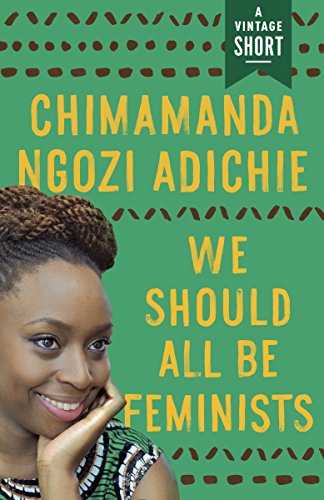
We Should All Be Feminists by Chimamanda Ngozi Adichie

Date Read: January 12th 2015

Published: July 2014

Publisher: Vintage Books

Pages: 23

Adichie Feminist

The Blurb

In this personal, eloquently-argued essay—adapted from her much-admired TEDx talk of the same name—Chimamanda Ngozi Adichie, award-winning author of Americanah, offers readers a unique definition of feminism for the twenty-first century, one rooted in inclusion and awareness. Drawing extensively on her own experiences and her deep understanding of the often masked realities of sexual politics, here is one remarkable author’s exploration of what it means to be a woman now—and an of-the-moment rallying cry for why we should all be feminists.

◊◊

Review– ★★★★ (4 stars)

Most of us know We Should All Be Feminists was first presented by Chimamanda Ngozi Adichie as a TED talk given in the United Kingdom at TEDxEuston in 2012. This talk became quite popular on YouTube, along with her first talk The Danger of a Single Story which she delivered in 2009. The essay We Should All Be Feminists became available to the public for purchase as an eBook in 2014 and I recently got a chance to purchase the eBook using my NookBook app.

Chimamanda Ngozi Adichie has a way of eloquently articulating complex issues by skillfully using simple words, and this is why I love her! Her essay/talk, We Should All Be Feminists is basically about her views on gender and how limited of a function society has made it. The term ‘feminist’ has had a bad rap for years, but Adichie proudly calls herself a feminist or better yet: A Happy African Feminist Who Does Not Hate Men and Who Likes to Wear Lip Gloss and High Heels for Herself and Not For Men”. In her essay, she compares how society has shaped the way girls and boys are raised and how problematic these ways can be. For example, she states that girls are taught to be likeable and not aggressive, while boys are taught to be strong, seldom showing emotion and fear.

The problem with gender is that it prescribes how we should be rather than recognizing how we are. Adichie believes we’d be happier and true to our identity if we didn’t have the weight of gender expectations on our shoulders. Men shouldn’t have to feign strength and (hyper) masculinity by always paying the bill for women or by stifling their emotions. Women shouldn’t feel invisible in the presence of men. Women shouldn’t feel shame or guilt whenever they desire to express anger or to simply state their noble opinions.

Adichie gives several examples of personal experiences and of other people she knows to further explain and prove her points on the problems of gender. I do not consider myself a ‘feminist’ and I don’t remember the last time I experienced prejudice because I am a girl, but I agree 100% with every single thing Adichie discusses in this essay. I think it will just take a long time for society to actually shift and become more flexible with the concept of gender and gender roles, but we will get there – one day.

My favorite quotes from We Should All Be Feminists:

 “Gender as it functions today is a grave injustice” pg. 12

“We do a great disservice to boys in how we raise them. We stifle the humanity of boys…. We teach boys to be afraid to fear, of weakness, of vulnerability. We teach them to mask their true selves, because they have to be, in Nigerian-speak – a hard man.” pg. 14

“A Nigerian acquaintance once asked me if I was worried that men would be intimidated by me. I was not worried at all- it had not occurred to me to be worried, because a man who will be intimidated by me is exactly the kind of man I would have no interest in.” pg. 14  [Girl, me too!]

“Some people ask: ‘Why the word feminist? Why not just say you are a believer in human rights, or something like that?’ Because that would be dishonest. Feminism is, of course, part of human rights in general- but to choose to use the vague expression human rights is to deny the specific and particular problem of gender.” pg. 18

“I was once talking about gender and a man said to me, ‘Why does it have to be you as a woman? Why not you as a human being?’ This type of question is a way of silencing a person’s specific experiences. Of course I am a human being, but there are particular things that happen to me in the world because I am a woman.” pg. 19

“Some people will say, Oh, but women have the real power: bottom power. (This is a Nigerian expression for a woman who uses her sexuality to get things from men.) But bottom power is not power at all, because the woman with bottom power is actually not powerful; she just has a good route to tap another person’s power.” pg. 20

This essay/talk is wonderful and I will surely read/listen to it again!

Watch the talk from the TEDxEuston event via YouTube below:

★★★★ (4 stars) – Great essay. Highly recommend!

Purchase We Should All Be Feminists (paperback) on Amazon

Happy New Year, everyone! I’m participating in the Goodreads 2015 Reading Challenge. Expect more reviews soon 🙂

2014 Recap & My Top 5!

If you’ve been following my book blog for some time, you would know that I participated in the Goodreads 2014 Reading Challenge and I pledged to read 12 books this year. Since I have a strong passion for African literature, as well as African-American and Caribbean literature, I challenged myself to indulge in books of those genres this year. I successfully surpassed my goal and ended up reading 15 books in 2014.

I started this blog because I needed to express my views on the books I read, especially with people around the world who have read some of these books. Over the years I’ve realized that simply discussing the issues of the books I read with friends doesn’t suffice for me, for many reasons. Writing reviews on this blog and expressing my opinions on the books I’ve read has beIMG_8741en fulfilling! It would be nice to actually discuss in detail the things I liked and disliked about the books, but I can’t include spoilers in my reviews – its always so tempting!

Check out all the books I read and reviewed this year in the Book Reviews section of the blog!

(note: I wasn’t able to finish reading Sozaboy: A novel in Rotten English by Ken Saro-Wiwa and The Palm-Wine Drinkard by Amos Tutuola. I just wasn’t feeling them at the time… And I think my ‘Currently Reading’ posts were jinxing my reading progress 😦 )

 Top 5 faves of my 2014 Reading Challenge

1. One Day I Will Write About This Place: A Memoir by Binyavanga Wainaina

2. Happiness, Like Water by Chinelo Okparanta

3. The Spider King’s Daughter by Chibundu Onuzo

4. Mom & Me & Mom by Maya Angelou

5. Harmattan Rain by Ayesha Harruna Attah

I plan on participating in the Goodreads 2015 Reading Challenge as well. I’d like to read more Caribbean novels next year, so we’ll see how that goes!

What were your favorite books of 2014?

IMG_1845

Thanks for all the support! See you in 2015 🙂

The Spider King’s Daughter by Chibundu Onuzo

Date Read: September 4th 2014

Published: 2012

Publisher: Faber and Faber Limited

Pages: 288

Spider King's Daughter cover

The Blurb

Seventeen-year-old Abike Johnson is the favourite child of her wealthy father. She lives in a sprawling mansion in Lagos, protected by armed guards and ferried everywhere in a huge black jeep.

A world away from Abike’s mansion, in the city’s slums, lives an eighteen-year-old hawker struggling to make sense of the world. His family lost everything after his father’s death and now he sells ice cream at the side of the road to support his mother and sister.

When Abike buys ice cream from the hawker one afternoon, they strike up a tentative and unlikely romance. But as they grow closer, revelations from the past threaten their relationship and both Abike and the hawker must decide where their loyalties lie.

 ◊◊

Review – ★★★★★ (5 stars)

Did you know that Chibundu Onuzo wrote The Spider King’s Daughter when she was 21 years old? I find that incredible! Her attention to detail of all the intricacies that could happen in a story involving two people are thoroughly explored, and I am very impressed! When I was reading this book, it felt like I was watching a Nigerian movie. The storyline is full of suspense, speculations and assumptions that could actually push this novel into the ‘thriller’ genre. The Spider King’s Daughter is a novel centered around two characters: Abike and Runner G.

Abike is a 17 year old spoiled brat, child of the Spider King- a mysterious, very wealthy man in Lagos. One day as she is chauffeured home from school, she spots a handsome hawker, Runner G, selling ice cream on the street. For days she tries to catch Runner G’s attention through her characteristic manipulative ways and finally starts a conversation with him on the street as she sits in her car. After some weeks, Abike and Runner G become friends and they spend their weekends together. Abike even invites this hawker, Runner G to her huge palace (againsts her father’s will) where they simply enjoy each others’ company and slowly fall in love. Their relationship seems to turn sour when Runner G starts to act strange around Abike, as others warn him of Abike’s true character.

Runner G is a street hawker who sells ice cream. He was not always a street hawker. He came from a middle-class home in the past. But after the death of his father- who was a lawyer, Runner G’s family fell into poverty. His mother is currently bed-ridden and depressed and he had to stop school and start hawking in order to pay his younger sister’s school fees. Runner G becomes Abike’s friend after she initiates conversation with him from her car in the street. He slowly falls in love with her, but later realizes she isn’t actually the person she portrays herself to be. Runner G hence starts to dig for information about Abike from her family members and her close friends who have nothing good to say about her. He later finds out that her lavish lifestyle, grâce à her father’s wealth, might actually be the reason why his family is in abject poverty.

The once cute-turned-dark love story between Abike and Runner G results in a truly unpredictable, shocking end, that pushes me to pity both Abike and Runner G.

The book was written from both Abike and Runner G’s perspectives- which was a bit confusing for me in the beginning. But it was great to see how two people could interpret an event or a day together in two completely different ways. Readers get to understand both Abike and Runner G’s thoughts and feelings towards the dynamic of their relationship and how possibly incompatible they actually are. I appreciated Onuzo’s commentary on hawker-life through Runner G’s character. It pushed me to actually put myself in their shoes and question the terrible economic disparities of our African nations.

Onuzo’s attention to detail was very impressive. Everything about this book, down to the smallest detail was great…it’s actually difficult to discuss this book without giving away spoilers. But I really really recommend this!

★★★★★ (5 stars) – Amazing book, I loved it. Absolutely recommend!

IMG_1333

Purchase The Spider King’s Daughter on Amazon